How Top Fintech Startups Engage Users
 Colin HeilbutAugust 03, 2020
This past month, I interviewed over 50 FinTech executives, primarily CTOs, VPEs, CPOs and engineering managers at mid-market product orgs. In each of these conversations, I had one central question in mind: “How do you currently manage notifications for your company?”
Below are a few key observations and one surprising takeaway.
Notifications are the central communication channel between the product and the market—the direct touch point between you and your users. Notifications are how your users will interact with you and how they will remember you. This is why having the right platform for managing event-driven notifications is one of the most important channels for user engagement, growth and retention.
This is especially true for fintech companies, where users need to know when their accounts are active, when their margin calls are issued, or when their transactions are declined. Even a few missed financial product alerts can have lasting repercussions for consumers and businesses alike, which is precisely why it’s increasingly important to have a multi-channel templating system—to have each notification be cross-compatible with multiple channels, ranging from SMS to email to Slack. That way, you can reach your users where they want to be reached. Of course, sending too many notifications can have an adverse effect, so it’s important to give users control over their preferences.
Every executive I’ve spoken to has told me that a rapidly scaling technology company needs a robust system in order to manage notification templates in a user-friendly way.
In short, any stakeholder, whether product manager or engineer, should be able to edit copy, reformat messages, analyze engagement, and track delivery with distribution channels and routing systems to ensure that notifications are properly delivered. Redundancy needs to be in place from the beginning so that if a user has opted out or a provider is down, the message will automatically route through another channel. Data security and regulatory compliance is another top priority in fintech, meaning any system implementation needs to also have enterprise-level protections such as encryption of data in transit and at rest, SOC 2 certification and GDPR/CCPA.
But building a system this robust takes thousands of engineering hours and a princely fortune to get right. Good executives know the value of strong technical systems and cannot afford to skimp on quality. The tradeoff is usually price and time.
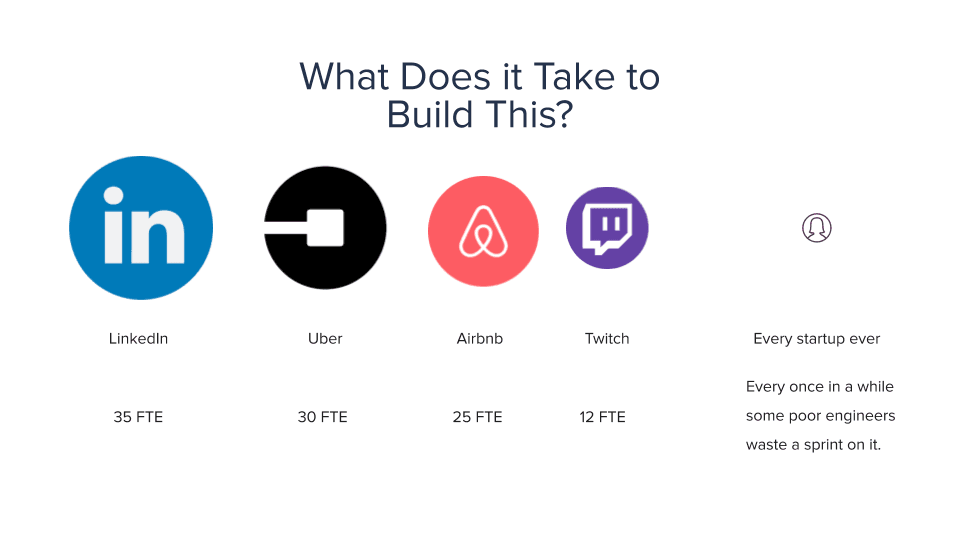
The most noteworthy observation from my many interviews came from a product leader of a rapidly-growing unicorn startup. In order for their business to stay operational, they needed to communicate with users on a regular basis—anything from ‘thank you for signing up’ to ‘there is a problem with your account, please login to review.’ In short, they needed a multichannel templating system so they built one in-house.
It cost them over 4000 engineering hours just to build template management, and much much more to build routing and message delivery microservices. All in all, their cost of building a notifications system internally was more than one million dollars. The worst part is they aren’t alone. Everyone I spoke with is sinking countless hours building the exact same capabilities as everyone else I spoke with.
For a long time, there were no good alternatives, this was just the cost of doing business. That is, until now. Courier is the easiest way to build and manage notifications over any channel.
If you're interested in learning more, click the button below and we'd be happy to share best practices from the organizations we spoke with and how you can use Courier to superpower your notifications!
Similar resources

WhatsApp Business messages: types, templates, and rules
Every WhatsApp Business message is a template or a free-form message, and the type decides when you can send it and what it can look like. How businesses use each one, the template categories, the formats worth knowing, and the rules that stop messages from arriving.

WhatsApp pricing changes on October 1, 2026
On October 1, 2026, two things become billable on the WhatsApp Business Platform: free-form replies inside the 24-hour customer service window, and utility templates sent in response to a customer. If your WhatsApp volume is conversations rather than campaigns, this is not a rate tweak. It adds a line to your invoice where there used to be a zero. Here is what changes, a worked example of the cost, and what to check.

Clinical alert and notification systems: how escalation works
A clinical alert is easy to send and hard to close. This is how alerting works inside a hospital: where alerts come from, how routing by role and shift works, and how the acknowledge, timeout, escalate loop is actually built, including what happens when nobody answers.