The Embedded Editor Showdown: Choosing the Right Embedded Editor for Your B2B Platform
 Thomas SchiavoneOctober 27, 2025
The Problem: B2B Platforms Need Customizable Notifications
If you are building a B2B platform, you are not just communicating with your own users. You are helping your customers communicate with theirs. Every message—an invoice, an alert, or a shipment update—carries your customer’s brand and voice.
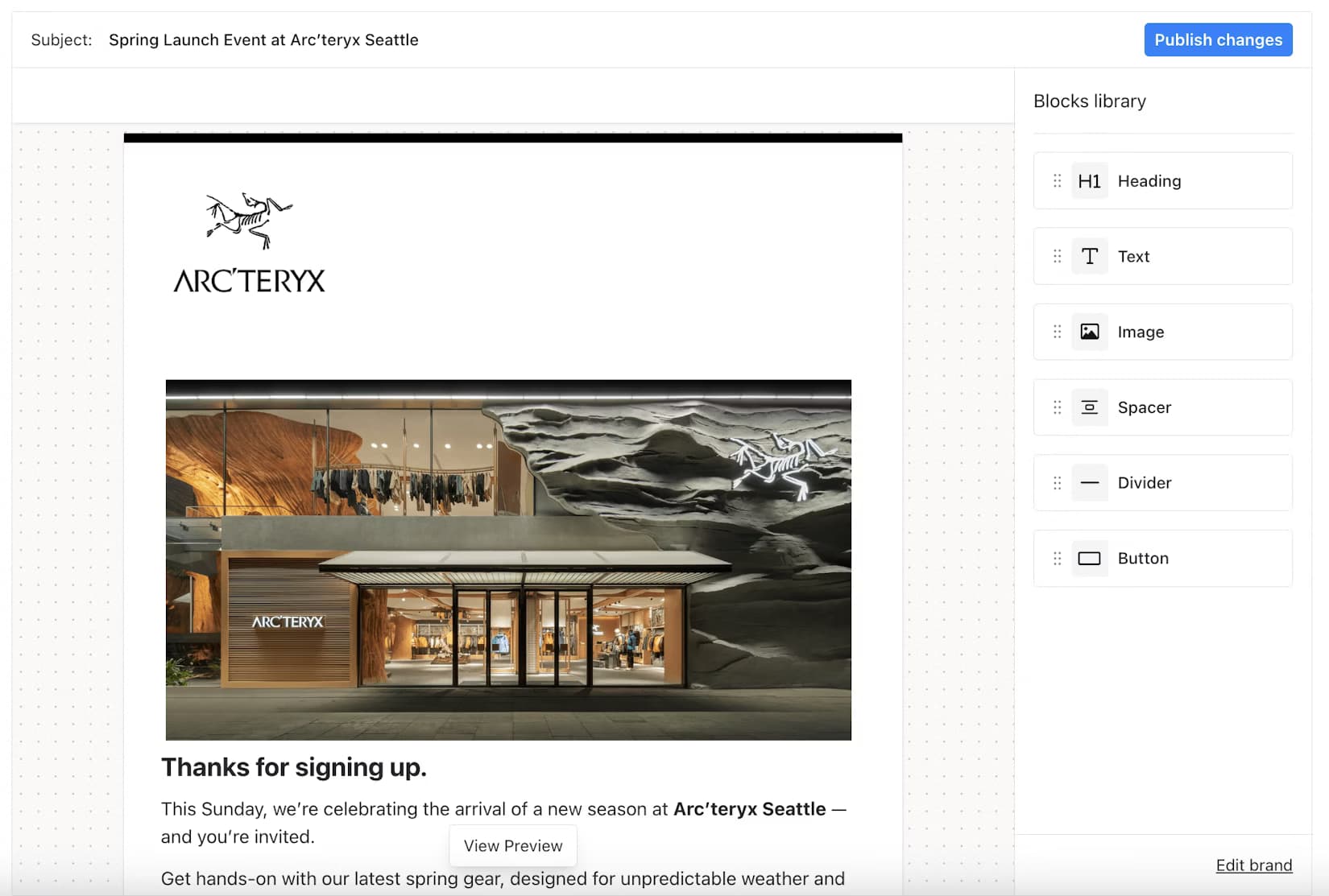
That creates a clear challenge. Each business wants to control how its notifications look and feel, but managing templates and designs for every account does not scale. An embedded notification designer solves that by giving customers a visual editor inside your product. They can create and manage their own messages across email, push, and in-app channels while you keep delivery consistent and secure.
This turns your product from a tool into a platform. Your customers gain autonomy and brand control, while your team gains scalability and fewer manual requests.
That is why we created Courier Create — to bring design and delivery together in one platform.
The Embeddable Editor Options at a Glance
When you decide to let your customers create and manage their own notifications, there are a few common paths to consider. Each comes with its own trade-offs in flexibility, speed, and maintenance.
1. Open-source editors
These tools give you full control of the code and the freedom to customize every detail. They can be a good fit if you have a large engineering team and the time to maintain a design system for every customer. The trade-off is that you also own the complexity. You must build the delivery logic, handle performance, and maintain infrastructure as your product scales.
2. Email-only embedded editors
These options are easier to integrate and usually work well for products that only send simple email messages. The limitation is that they stop at the design layer. When your customers need to reach users through push, SMS, or in-app notifications, you will have to rebuild that logic yourself.
3. A multi-channel editor with delivery built in
This is where Courier Create fits. It gives your customers a powerful, embedded design experience while handling the delivery, routing, and observability behind the scenes. You stay focused on your product, and your customers get the flexibility to own their brand and communication.
Open-Source Editors and What You Are Signing Up For
Many platform teams start with open-source editors. Tools such as GrapesJS, Mosaico, Pell, CKEditor 5, and TinyMCE give you complete control of the design layer. You can customize the interface, add new content blocks, and host everything inside your own environment. For an engineering-heavy team, that flexibility can look appealing. You can make the editor fit your product’s interface and control every detail of the user experience.
The challenge appears when you start scaling. These editors focus on visual design, not on what happens next. You still have to store templates, manage message routing, handle retries, and monitor delivery. Each time a customer requests a new channel or a branded variant, you are back in the code.
If your product serves many businesses, the maintenance quickly becomes a full-time job. Each tenant needs its own templates, assets, and configuration. Without built-in delivery and observability, the work never really ends.
Courier Create was built to solve that problem. It gives your customers the same creative control they expect from open-source tools while handling delivery, routing, and analytics through the Courier platform. You get the control of embedding your own experience without the overhead of building a notifications system from scratch.
Embeddable Editor Comparison Matrix
When you are building a platform that serves other businesses, the decision is not just about how an editor looks. It is about how well it scales, how much you will need to maintain, and how much control your customers will have inside your product.
| Criteria | Open-Source Editors | Email-Only Embedded Editors | Courier Create |
|---|---|---|---|
| Channels | Email only and requires extensions for SMS, push, or in-app | Email only | Native support for email, SMS, push, chat, and in-app |
| Delivery Integration | None. You must build routing and retries yourself | None. Design layer only | Delivery, routing, and fallbacks included |
| Observability | Custom dashboards required | Limited or none | Message tracking, analytics, and logs built in |
| Multi-Tenancy | Not supported | Not supported | Templates and brand isolation per tenant |
| Branding and White Label | Manual setup for each customer | Basic theming | Full white-label branding for each tenant |
| Maintenance | High. You own updates and hosting | Low but limited flexibility | Managed by Courier |
| Developer Effort | High. Build and maintain integrations | Low at first, increases with scope | Low. Embed once and scale across channels |
| Time to Market | Slower setup and infrastructure needs | Quick to start for simple use cases | Fast to launch and scale |
| Scalability | Depends on your own infrastructure | Limited to email volume | Designed for scale across channels and customers |
| Ideal For | Engineering-heavy teams that need full control | Products that only send email | Platforms that serve many business customers and need multi-channel communication |
Open-source editors such as GrapesJS and TinyMCE give you building blocks. Email-only editors help you get started quickly. Courier Create gives you the complete system that combines design, delivery, and observability.
Learn more about embedding Courier Create into your platform in the Courier Create documentation.
The Real Shortcomings: Where Most Editors Fall Short
For B2B platforms, giving customers control is only valuable if the experience scales. Most editors on the market stop at design. They let users create templates but leave everything that happens after that up to you. Delivery, routing, observability, and reliability still have to be built and maintained by your team.
That might work for a single tenant or a handful of customers, but it does not hold up when you are serving hundreds or thousands of businesses. Each one needs its own templates, brand assets, and delivery preferences. Managing all of that manually or across disconnected tools quickly becomes a bottleneck.
Courier Create closes that gap by combining design and delivery in one platform. You can embed a fully featured editor that empowers your customers to design their own messages, while Courier handles the routing, delivery, and visibility across every channel.
Why Design and Delivery Matter
Designing a message is only part of the job. A customer can create the perfect layout and copy, but it will not matter if the message never reaches their users or if no one knows whether it did. Delivery is where reliability and visibility meet, and it is what separates a design tool from a complete communication system.
For B2B platforms, this becomes even more important. Each customer expects their messages to arrive through the right channel, in the right format, and under their own brand. Handling that logic across hundreds or thousands of tenants requires delivery rules, retries, and analytics that most editors are not built to support.
Courier Create is built on top of Courier’s multi-channel delivery engine, so every message designed inside the editor is ready to send immediately. You can test, route, and observe messages across email, push, SMS, chat, and in-app notifications all from one place. There is no need to build separate pipelines or reporting systems.
When design and delivery exist together, your customers gain confidence and control, and your team gains time and stability. It is a better experience for both sides of the platform.
Built for Scale: Tenants, Branding, and Control
When your product serves businesses, you are really serving many brands at once. Each customer expects the messages they send through your platform to reflect their identity, not yours. They want their own templates, colors, logos, and tone of voice. At the same time, you need to make sure those experiences are consistent, secure, and easy to manage.
Courier Create was built for this multi-tenant world. Each customer can work in a fully isolated space where their templates, assets, and data are separate from everyone else’s. They can design and manage notifications that look and feel like their brand, while your platform stays safe and compliant.
Branding is fully customizable. Customers can apply their own logos, color schemes, and layouts without breaking your product’s structure or delivery logic. You can embed the same powerful editor in every tenant’s account and give them full creative control while maintaining one reliable backend.
This approach saves your team time and lets your customers move faster. Instead of handling template updates and brand requests yourself, you empower every business to manage its own communication experience directly inside your product. It turns personalization from a feature request into a built-in advantage of your platform.
How to Choose the Right Embedded Editor
Choosing the right editor for your platform is about more than design features. It is about how much of the communication stack you want to build and maintain, and how much control you want to give your customers. Use the questions below to evaluate what matters most for your product and your business.
- Channels: Does it support more than email? Can it handle SMS, push, chat, and in-app notifications as your customers expand their communication strategies?
- Delivery Integration: Can messages be sent, retried, and tracked automatically, or will you need to build that infrastructure yourself?
- Observability: Can you and your customers see message status, errors, and metrics without building custom dashboards?
- Multi-Tenancy: Can each customer safely manage their own templates and data without risk of overlap?
- Branding Control: Can every customer apply their own logo, color palette, and layout while you maintain structure and compliance?
- Developer Experience: How easy is it to embed, update, and scale the editor as your platform grows?
The right embedded editor does more than let customers design notifications. It helps you offer a complete, branded communication experience inside your product without creating new work for your team.
Design and Deliver — All in One Platform
If your product helps other businesses communicate with their customers, notifications are not a side feature. They are a core part of the value you deliver. Every alert, invoice, and update that goes out through your platform represents your customer’s brand, not yours. Getting those messages right builds trust for them and credibility for you.
Courier Create brings everything you need into one system. It gives your customers a modern, embedded design experience and connects it directly to Courier’s delivery and observability engine. They can create, preview, and send messages across all channels while your platform stays fast, reliable, and easy to maintain.
You are no longer managing templates or building routing logic for every account. You are giving every customer the ability to design and deliver their own branded communication with confidence.
Courier Create turns messaging from an internal engineering challenge into a self-serve product capability. It helps your platform scale while empowering every business you serve.
Similar resources

WhatsApp pricing changes on October 1, 2026
On October 1, 2026, two things become billable on the WhatsApp Business Platform: free-form replies inside the 24-hour customer service window, and utility templates sent in response to a customer. If your WhatsApp volume is conversations rather than campaigns, this is not a rate tweak. It adds a line to your invoice where there used to be a zero. Here is what changes, a worked example of the cost, and what to check.

Clinical alert and notification systems: how escalation works
A clinical alert is easy to send and hard to close. This is how alerting works inside a hospital: where alerts come from, how routing by role and shift works, and how the acknowledge, timeout, escalate loop is actually built, including what happens when nobody answers.

Courier vs Customer.io: 2026 messaging platform comparison
Courier and Customer.io both send across email, push, SMS, and in-app, but they are not priced or built the same way. Courier bills by the send, puts journeys, experiments, broadcasts, an in-app inbox, preferences, and 50+ delivery providers on one platform, and exposes all of it through an API, a CLI, and an MCP server. Customer.io bills by the number of profiles in your database and fits a marketing team that needs deep behavioral segmentation. This comparison covers pricing, journeys, channels, in-app messaging, localization, and preferences, with every competitor figure linked to Customer.io's own pages.