AI Is Changing How Users Discover Products
 Thomas SchiavoneMarch 27, 2025
Search is evolving—and fast. At Courier, we’ve started to see a shift in how users are finding us.
Google still dominates product discovery. It remains the primary starting point for most users—and for most products, the largest source of referral traffic.
But something new is happening.
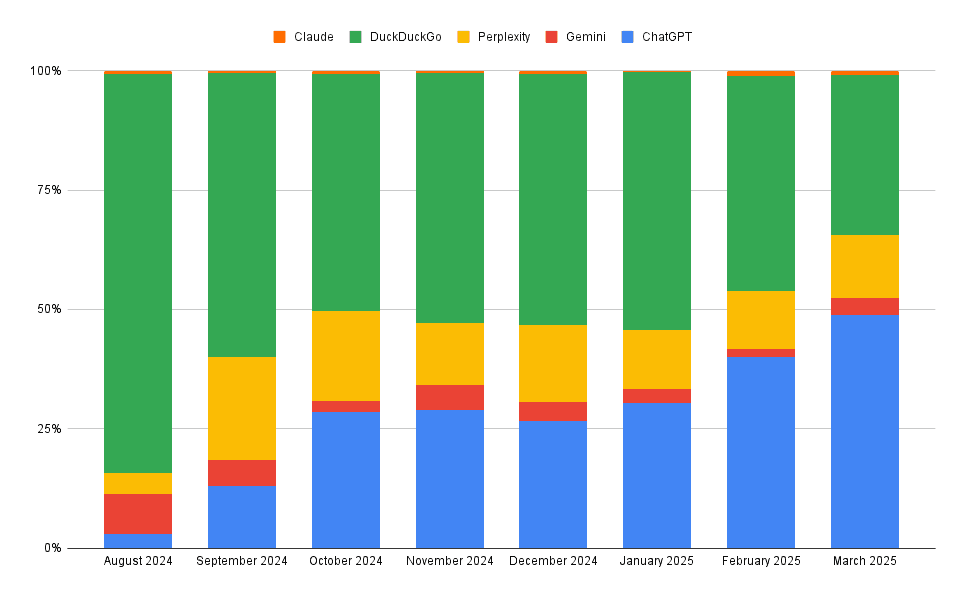
Over the past six months, ChatGPT has become a meaningful source of inbound traffic. It has already overtaken DuckDuckGo in our referral data and, at its current pace, will surpass Bing this year.
Perplexity showed early promise and gained traction among technical users, but its growth has since plateaued. We’ll come back to that.
Other tools, like Anthropic’s Claude, have recently introduced web search capabilities, but they barely register in our data. This shift isn’t about AI in general—it’s about a very specific change in behavior: people are using ChatGPT to find and access products directly.
And that’s starting to show up in the numbers. Here’s a breakdown of referral traffic from AI chat tools compared to DuckDuckGo, our lowest-performing search engine.
ChatGPT Is Becoming a Discovery Surface
When traffic from ChatGPT first appeared, it was a novelty. But since late 2024, that trickle has turned into a steady, measurable trend.
Month over month, ChatGPT has grown faster than any other non-Google source.
Today, it’s not just outpacing DuckDuckGo—it’s catching up to Bing. And this isn’t the result of a one-time spike. It reflects a real shift in how users are finding products.
This isn’t something to watch passively. It’s time to treat ChatGPT the way you treat search engines. The mechanics are different, but the effect is the same: visibility matters. The more clearly and authoritatively your product shows up in AI-generated answers, the more likely it is users will click through and engage.
ChatGPT vs. Bing: The Gap Is Closing
Bing has been a steady, if modest, source of referral traffic for years. But ChatGPT is closing in—fast. If trends hold, it will overtake Bing within the next six months.
That said, our data may reflect the nature of our product. Courier is built for developers and product teams—audiences who are often ahead of the curve in adopting new tools like ChatGPT. Our content also aligns well with the kinds of queries AI tools can answer today: implementation questions, comparisons, integration how-tos.
That might not be true yet for other products... yet. As search models improve and user behavior shifts, we expect this pattern to extend well beyond technical categories.
Perplexity: Early Traction, Then a Plateau
Perplexity was one of the first AI tools we saw show up in our referral data. It gained traction quickly and briefly looked like it could become a meaningful channel.
But since then, growth has stalled. Traffic from Perplexity has remained flat, even as ChatGPT continues to climb.
The most likely reason comes down to brand and distribution. ChatGPT benefits from massive exposure and widely regarded as the default AI interface. Perplexity, while respected in certain circles, doesn’t have the same reach or default presence.
It still appears in our data—but it’s not growing. That’s not a good sign for Perplexity’s long-term relevance as a discovery surface.
Claude: Present in the Market, Absent in the Data
Anthropic’s Claude has been in the market a while but it’s the lowest by far among the AI assistants we track (we're giving Grok a pass for now).
This isn’t surprising. The dominant way Claude is used today is through its API, not its user interface. That may change over time. But today, Claude simply isn't showing up as part of the product discovery journey—not in any meaningful volume.
Google Still Dominates—But It’s No Longer Alone
Google continues to drive the majority of our discovery traffic. That hasn’t changed.
But the landscape around it is shifting. ChatGPT is now a serious alternative. And even Google is adapting. Gemini—Google’s own AI assistant—has started to appear in our referral data. It’s still small, but it’s growing. AI-assisted search is clearly becoming a core part of Google’s future.
For now, Google remains dominant. However, AI assistants are no longer a novelty—they’re becoming the new front door to the internet.
Similar resources

Courier vs Customer.io: 2026 messaging platform comparison
Courier and Customer.io both send across email, push, SMS, and in-app, but they are not priced or built the same way. Courier bills by the send, puts journeys, experiments, broadcasts, an in-app inbox, preferences, and 50+ delivery providers on one platform, and exposes all of it through an API, a CLI, and an MCP server. Customer.io bills by the number of profiles in your database and fits a marketing team that needs deep behavioral segmentation. This comparison covers pricing, journeys, channels, in-app messaging, localization, and preferences, with every competitor figure linked to Customer.io's own pages.

Your notification analytics are now available by API
If it's in the Courier dashboard, it's on the API. Analytics was one of the last screens where that wasn't true. GET /notifications/{id}/metrics returns sends, deliveries, opens, clicks, errors, and undeliverable counts per template as a time series, broken out by provider and channel, so the numbers can live in your own product or go straight to an agent.

Top 11 push notification platforms compared for 2026
Push starts as the whole job, then product wants an email fallback, legal wants a preference center, and support wants a searchable log. This guide compares 11 push notification platforms on channels, free tiers, and pricing, and shows why Courier's single API for push, email, SMS, in-app inbox, Slack, and Microsoft Teams fits that arc better than a push-only tool. Includes 2026 opt-in and open-rate benchmarks, a full-stack cost comparison, and what each platform leaves you to build.