Designing Slack Notifications using Block Kit and Jsonnet
 Aydrian HowardSeptember 02, 2020
Earlier this summer, Riley Napier from our engineering team joined me for our June 24th Courier Live to help me build a Slack Slash Command to display estimated departure times for BART Stations. We created a Glitch ExpressJS app to accept the commands and Courier to handle the responses. We designed the messages by dynamically generating Block Kit using Jsonnet.
Check out the video below to watch us:
- Walk through setting up a Glitch App that handles Slack Slash Commands
- Create a notification for Slack
- Use the Jsonnet Block to dynamically create Block Kit elements
Find the full project code on the Courier Slack Slash Bart Glitch App.
Be sure to Like the video and Subscribe to our YouTube channel.
What is Jsonnet?
Jsonnet is a powerful data templating language for JSON. It has a Python-like syntax that allows you to build JSON output using variables, functions, conditionals, etc. This comes in handy when dynamically creating Block Kit elements for Slack. Courier provides the following functions that allow you to grab data and profile information.
# Grab values by JSON path from data passed during sendlocal data = data("path", "default");# Grab values by JSON path from merged recipient profilelocal profile = profile("path", "default");
For an overview of the basics of Jsonnet syntax, check out Learn Jsonnet in Y minutes.
Displaying BART Station Departure Times
To display the Departure Times passed to the notification, we used variables, functions, and list comprehensions to generate the resulting Block Kit sections. We started with the following data originating from the BART API:
{"data": {"date": "09/01/2020","time": "06:50:01 AM PDT","station": {"name": "Powell St.","abbr": "POWL","etd": [{"destination": "Antioch","abbreviation": "ANTC","limited": "0","estimate": [{"minutes": "7","platform": "2","direction": "North","length": "10","color": "YELLOW","hexcolor": "#ffff33","bikeflag": "1","delay": "0"},{"minutes": "37","platform": "2","direction": "North","length": "10","color": "YELLOW","hexcolor": "#ffff33","bikeflag": "1","delay": "0"},{"minutes": "66","platform": "2","direction": "North","length": "10","color": "YELLOW","hexcolor": "#ffff33","bikeflag": "1","delay": "0"}]},{"destination": "Berryessa","abbreviation": "BERY","limited": "0","estimate": [{"minutes": "9","platform": "2","direction": "North","length": "10","color": "GREEN","hexcolor": "#339933","bikeflag": "1","delay": "0"},{"minutes": "39","platform": "2","direction": "North","length": "10","color": "GREEN","hexcolor": "#339933","bikeflag": "1","delay": "0"}]}]},"message": ""}}
Using a Jsonnet block, we used the following Jsonnet code to render the Block Kit Sections
local station = data("station");local get_image(color, direction) ="https://dummyimage.com/100x100/%s/000000.png&text=%s" % [color[1:], direction];local get_cars(length) = std.join("", [ ":train:" for x in std.range(1, std.parseInt(length))]);local is_bike(flag) =if flag == "1" then "\n:bike:" else "";local get_estimate(estimate) ={"type": "section","text": {"type": "mrkdwn","text": ":clock4: *%s min*\nPlatform %s\n%s %s" % [estimate.minutes, estimate.platform, get_cars(estimate.length), is_bike(estimate.bikeflag)]},"accessory": {"type": "image","image_url": get_image(estimate.hexcolor, estimate.direction),"alt_text": "%s %s" % [estimate.direction, estimate.color]}};local get_estimates(estimates) =[get_estimate(estimate)for estimate in estimates];local get_destinations(etd) =[{"type": "section","text": {"type": "mrkdwn","text": "*%s*" % etd.destination}}] + get_estimates(etd.estimate) +[{"type": "divider"}];std.flattenArrays([get_destinations(etd)for etd in station.etd])
This results in Block Kit that looks like the following:
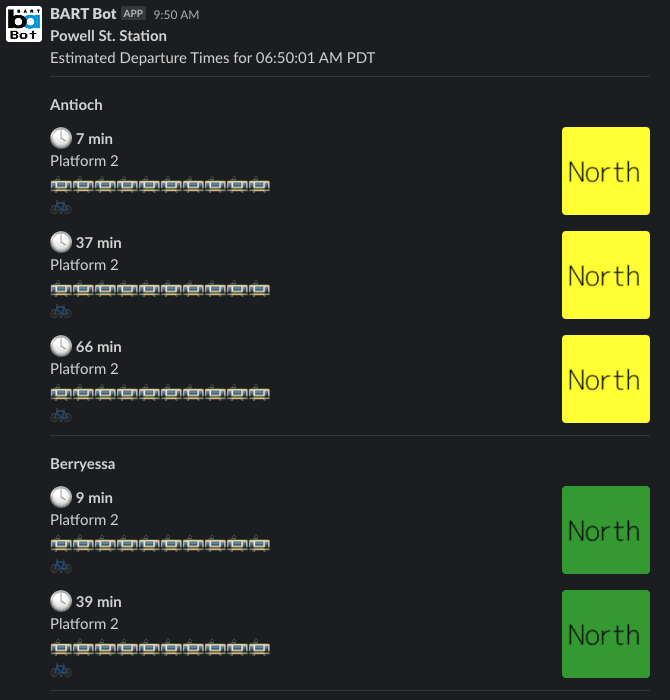
Feel free to remix our Glitch app and create your own Slack Slash Command. Be sure to let us know what you create.
Is there something you’d like to see us do using Courier? Let us know and it might be the subject of our next Courier Live. We stream a new Courier Live every Wednesday at noon Pacific. Follow us on Twitch to be notified when we go live.
-Aydrian
Similar resources

Clinical alert and notification systems: how escalation works
A clinical alert is easy to send and hard to close. This is how alerting works inside a hospital: where alerts come from, how routing by role and shift works, and how the acknowledge, timeout, escalate loop is actually built, including what happens when nobody answers.
How to send Slack notifications from your app
Slack is where your customers already work, which makes it a product surface rather than only an internal alerting channel. Posting an approval request or a status change into a customer's own Slack means working in workspaces you don't own, addressing people by email rather than Slack ID, and holding a separate credential for every customer.
How Product Teams Build, Test and Ship Multichannel Notifications in Design Studio
Product teams need to build, test, and ship notifications across multiple channels without filing an engineering ticket every time. Courier's Design Studio is the workspace for that: a template builder, visual channel routing, omnichannel testing, and publishing in one place. This post walks through the traditional template designer paradigm, how it splits effort across too many tools, and outlines a path for product and growth teams to ship transactional, product, and marketing notifications from a single workspace.