What Most People Get Wrong About Push Notification Metrics
 Kyle SeylerSeptember 18, 2025
Push Notification Metrics That Actually Drive Business Growth
TL;DR: Most teams track push notification engagement metrics that miss real business impact. While open rates and click-through rates provide surface-level insights, the notifications driving conversions and meaningful user behavior changes often go unrecognized. Focus on conversion attribution and cross-channel template performance to measure what truly drives revenue and user retention.
Push notification analytics have evolved beyond traditional engagement metrics, yet many teams still rely on outdated measurement approaches that obscure real business value.
The challenge lies in applying email marketing metrics to push notifications without considering fundamental differences in user behavior and platform constraints. A notification that never gets "opened" might still drive a purchase decision or prevent user churn. Low engagement rates often mask successful behavior changes that generate revenue.
This measurement disconnect creates strategic blind spots. When you cannot identify which notifications move business metrics, optimizing your communication strategy becomes guesswork rather than data-driven decision making.
In This Article
- Understanding Push Notification Uniqueness
- Tracking Delivery Rates Effectively
- Why Open Rates Mislead Business Decisions
- Cross-Channel Analytics for Complete Visibility
- Measuring Conversions That Matter
- Template Performance Across Channels
- Advanced Tracking Capabilities
- Common Notification Pitfalls
- Building Data-Driven Strategies
- Frequently Asked Questions
Understanding Push Notification Uniqueness
Push notifications serve distinctly different purposes across business applications compared to traditional marketing channels. Rather than driving immediate engagement like social media notifications, they facilitate complex workflows, communicate critical updates, and guide users through sophisticated business processes.
Consider enterprise project management platforms sending notifications about budget approvals, deadline changes, or team assignments. These notifications might not generate immediate clicks, but they maintain team productivity and workflow continuity. The business value lies in awareness and process facilitation, not instant engagement responses.
These notifications also face unique delivery challenges. Users receive notifications across multiple applications, creating notification fatigue. Cross-device and cross-platform tracking adds complexity. Decision-making cycles often extend weeks or months rather than hours, requiring attribution windows that traditional metrics cannot capture.
Courier's Push Notification Infrastructure
Courier's unified push notification platform addresses these complexities by providing consistent tracking across Firebase FCM, Expo, Apple, and other providers. The platform normalizes delivery reporting differences between iOS and Android, giving you unified visibility into notification reach across your entire user base.
Understanding these fundamental differences shapes effective measurement strategies. Push metrics must account for influenced behaviors, long-term engagement patterns, and business outcome alignment rather than immediate response rates alone.
Tracking Delivery Rates Effectively
Delivery rate represents your foundational metric: the percentage of notifications successfully reaching target devices. For business applications, this metric carries critical importance because missed notifications can disrupt essential processes and workflows.
However, delivery tracking in push notifications faces inherent platform limitations. Mobile operating systems do not always report delivery status accurately, and network conditions affect reporting reliability. Enterprise environments introduce additional complexity through MDM systems, firewalls, and security policies that impact delivery success.
Courier's Unified Delivery Tracking
Courier's push notification infrastructure provides automatic delivery status updates when available, aggregating data across all your push providers. This unified approach helps identify delivery issues before they impact business operations.
The platform handles provider-specific delivery reporting differences, normalizing metrics across iOS and Android platforms. Unlike managing multiple provider dashboards separately, Courier centralizes all delivery data in a single analytics interface.
Key delivery tracking capabilities include:
- Automatic status aggregation across Firebase FCM, Expo, Apple, and other providers
- Real-time delivery reporting when supported by the underlying platform
- Unified metrics dashboard that eliminates the need to monitor multiple provider interfaces
- Enterprise-grade reliability with support for MDM systems and corporate firewalls
Why Open Rates Mislead Business Decisions
Push open rates measure the percentage of delivered notifications that users actively tap to open. While this metric appears straightforward, it often misleads teams working on applications where notifications serve informational rather than navigational purposes.
Users frequently consume notification content without opening the notification itself. Status updates about project completion, reminders about upcoming deadlines, or alerts about system maintenance deliver complete value through notification preview text alone.
Consider this common enterprise scenario: A team lead receives a notification that their quarterly budget request received approval. The notification title and preview contain all necessary information. The user processes this update and continues working without tapping the notification. Traditional metrics would classify this as "unopened," yet the notification successfully achieved its business purpose.
Platform differences further complicate business open rate interpretation. iOS notifications appear briefly then move to the notification center, while Android notifications persist until dismissed. Enterprise users often batch-clear notifications, leading to accidental opens that distort engagement metrics.
How Courier Tracks Beyond Open Rates
Courier's analytics platform monitors influenced behaviors and conversion events beyond traditional open rate tracking. The platform tracks when users take actions within your application after receiving notifications, even when they never technically "open" the push notification itself.
Rather than fixating on open rates alone, successful teams focus on whether notifications successfully communicate intended information and influence desired user behaviors.
Cross-Channel Analytics for Complete Visibility
Effective notification strategies span multiple communication channels, making cross-channel analytics essential for understanding true performance impact. Users might receive push notifications on mobile devices, email updates at their desks, and in-app messages during active application sessions.
Courier's Comprehensive Cross-Channel Platform
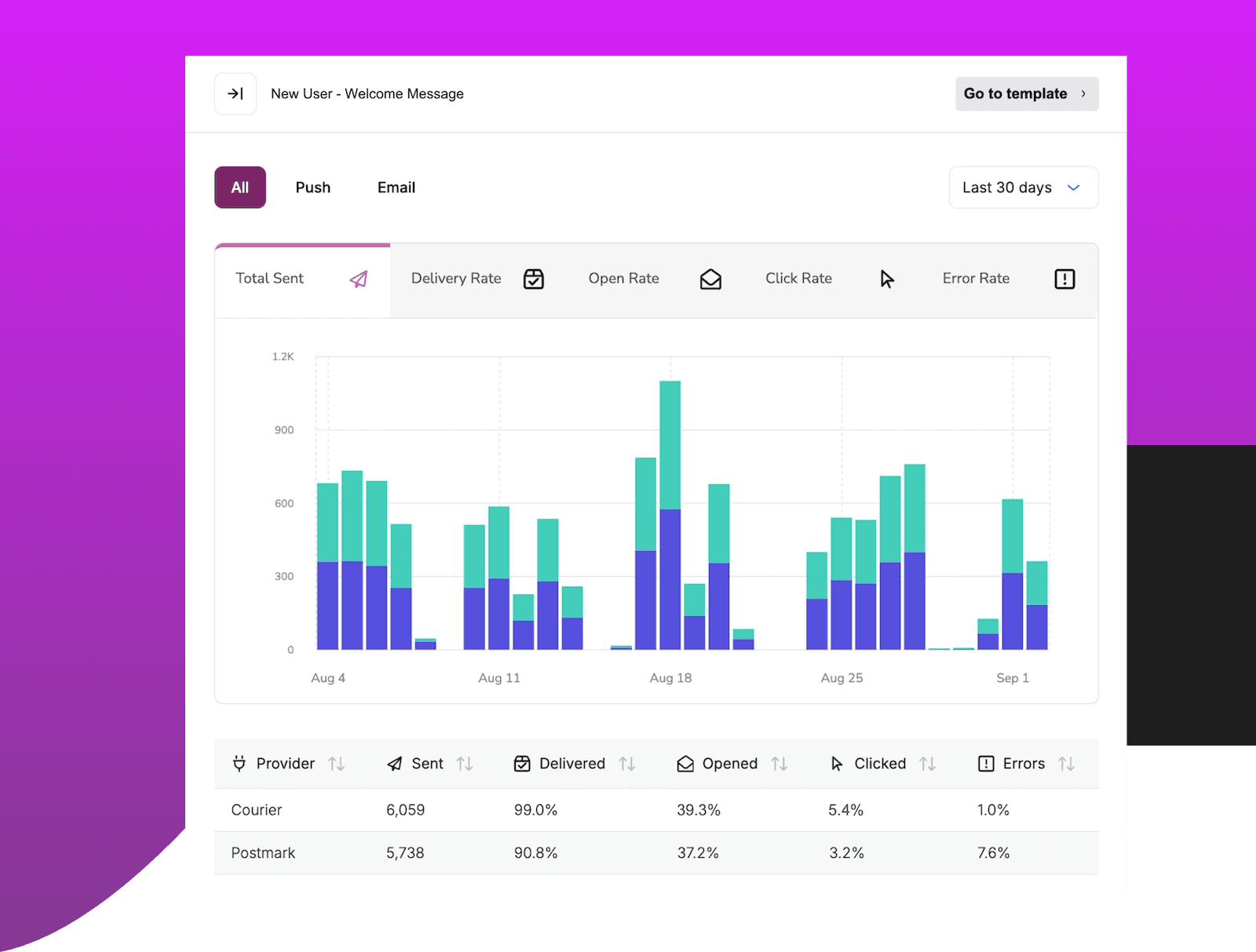
Courier's analytics dashboard provides unified cross-channel insights, tracking template performance across push, email, SMS, and in-app channels. The platform offers template-level analytics with detailed data on send volume, delivery rates, opens, clicks, and errors for each channel and provider combination.
Recent analytics enhancements have improved visibility and reporting capabilities across the entire notification ecosystem.
Unlike point solutions that track single channels, Courier provides unified visibility into your complete notification strategy performance. You can identify which channels complement each other and discover optimization opportunities across your entire communication infrastructure.
Email analytics reveal different engagement patterns across application types. Open rates tend higher when users check email regularly during business hours, but click rates may decrease when emails serve purely informational purposes. Courier's email tracking capabilities provide detailed engagement data for understanding these behavioral patterns.
SMS analytics expose another communication effectiveness dimension. While SMS typically achieves high delivery rates, engagement patterns vary significantly based on message urgency and user preferences. Courier's message logging system tracks SMS delivery status across carriers and regions, helping optimize send timing and content strategies.
In-app message analytics show immediate engagement during active user sessions but miss users who are not currently using the application. Understanding when and how users engage with in-app messages helps optimize timing and placement for maximum business impact.
Measuring Conversions That Matter
Conversion tracking represents the most critical metric for push notifications because it measures actual business impact rather than engagement proxy metrics. Unlike simple app opens or content views, meaningful conversions typically involve complex actions like completing workflows, making purchasing decisions, or adopting new platform features.
Conversion attribution often requires longer measurement windows than traditional marketing channels support. A notification about new feature availability might influence a purchasing decision weeks later. Status updates might prevent costly project delays. System alerts might enable proactive maintenance that avoids expensive downtime.
Connecting Push Metrics to Your Customer Data Platform
The real analytical power emerges from connecting push notification performance to existing analytics infrastructure. Courier's Segment integration automatically sends push engagement events to your analytics stack, providing complete visibility into how notifications impact your broader conversion funnel.
When users interact with push notifications, Courier automatically tracks events including "notification_delivered", "notification_opened", and "notification_clicked" back to Segment. Here's what gets tracked:
{"event": "notification_delivered","properties": {"channel": "push","template": "feature-announcement","provider": "firebase-fcm","message_id": "1-abc123","user_id": "enterprise_user_456","campaign": "q4-feature-rollout"}}
This event data flows into your existing analytics tools, enabling you to connect push performance to downstream conversion events, user activation metrics, and revenue attribution models.
This integration eliminates the gap between notification delivery and business outcomes, providing attribution data needed to optimize your entire communication strategy based on measurable business impact. Learn more about implementing Courier's Segment integration.
Courier's Analytics Foundation for Business Intelligence
Courier's analytics provide the foundation for sophisticated conversion tracking by monitoring notification lifecycle events from creation through delivery. The platform tracks comprehensive engagement events including opens and clicks, enabling you to connect notification performance to business outcomes and user behavior patterns over extended time periods.
Template Performance Across Channels
Template effectiveness varies dramatically across different communication channels. A message that performs exceptionally well in email might fail completely in push notifications due to character limitations, formatting constraints, or differing user context expectations.
Courier's template analytics reveal these performance variations, showing how identical content performs across push, email, SMS, and in-app channels. The platform's enhanced analytics capabilities provide detailed insights into template performance optimization across channels.
This intelligence enables optimization strategies that match specific message types to optimal delivery channels. For example, detailed feature announcements might perform better in email where users have more screen space and time for reading. Urgent system alerts might prove most effective via push notifications for immediate awareness. Status updates might work best in-app where users can take immediate follow-up actions.
Teams can leverage this data to create channel-specific content strategies rather than using generic one-size-fits-all templates across all communication channels.
Courier's Template Performance Intelligence
Courier's template analytics provide comprehensive performance data across all channels, showing sends, delivered messages, opens, clicks, and errors for each channel and provider combination. This data helps determine the ideal channel and provider for each notification template, enabling data-driven optimization of your complete notification strategy.
Advanced Tracking Capabilities
Sophisticated notification strategies benefit from advanced tracking that extends beyond basic delivery and engagement metrics. Advanced tracking reveals user behavior patterns, identifies optimization opportunities, and demonstrates clear ROI to business stakeholders.
Consider implementing tracking for user journey progression, feature adoption rates, workflow completion metrics, and business outcome correlation. This data helps prove notification program value and guides strategic decisions about messaging frequency, optimal timing, and content effectiveness.
Integration with business intelligence tools amplifies tracking value by connecting notification metrics to broader business KPIs including customer lifetime value, churn reduction rates, and revenue attribution models.
Key Advanced Tracking Metrics to Consider:
- User journey progression
- Track how notifications move users through specific workflows
- Feature adoption rates
- Measure if feature announcement notifications drive actual usage
- Workflow completion metrics
- Monitor if process notifications improve task completion
- Business outcome correlation
- Connect notifications to revenue, retention, and growth metrics
- Long-term attribution
- Track conversions that occur weeks or months after notification delivery
Common Notification Pitfalls
Notification programs face unique challenges that can undermine business effectiveness. Avoid these common strategic mistakes:
Over-notifying users: Users have limited attention spans and notification tolerance. Every notification should serve a clear business purpose and provide genuine user value.
Ignoring user preferences: Different users need different information at different times. Segment notifications based on user behavior patterns, stated preferences, and historical engagement data.
Neglecting compliance requirements: Many industries have specific communication requirements and regulations. Ensure your notification strategy meets relevant compliance standards and privacy regulations.
Forgetting integration complexity: Modern business applications involve complex system integrations. Test notification delivery across all systems and configurations your users might encounter.
Building Data-Driven Notification Strategy
Success with push notifications requires treating them as components of a broader communication ecosystem rather than isolated engagement tactics. Focus on measurable business outcomes, track long-term impact, and optimize based on user value creation rather than engagement vanity metrics.
Why Teams Choose Courier for Notification Analytics
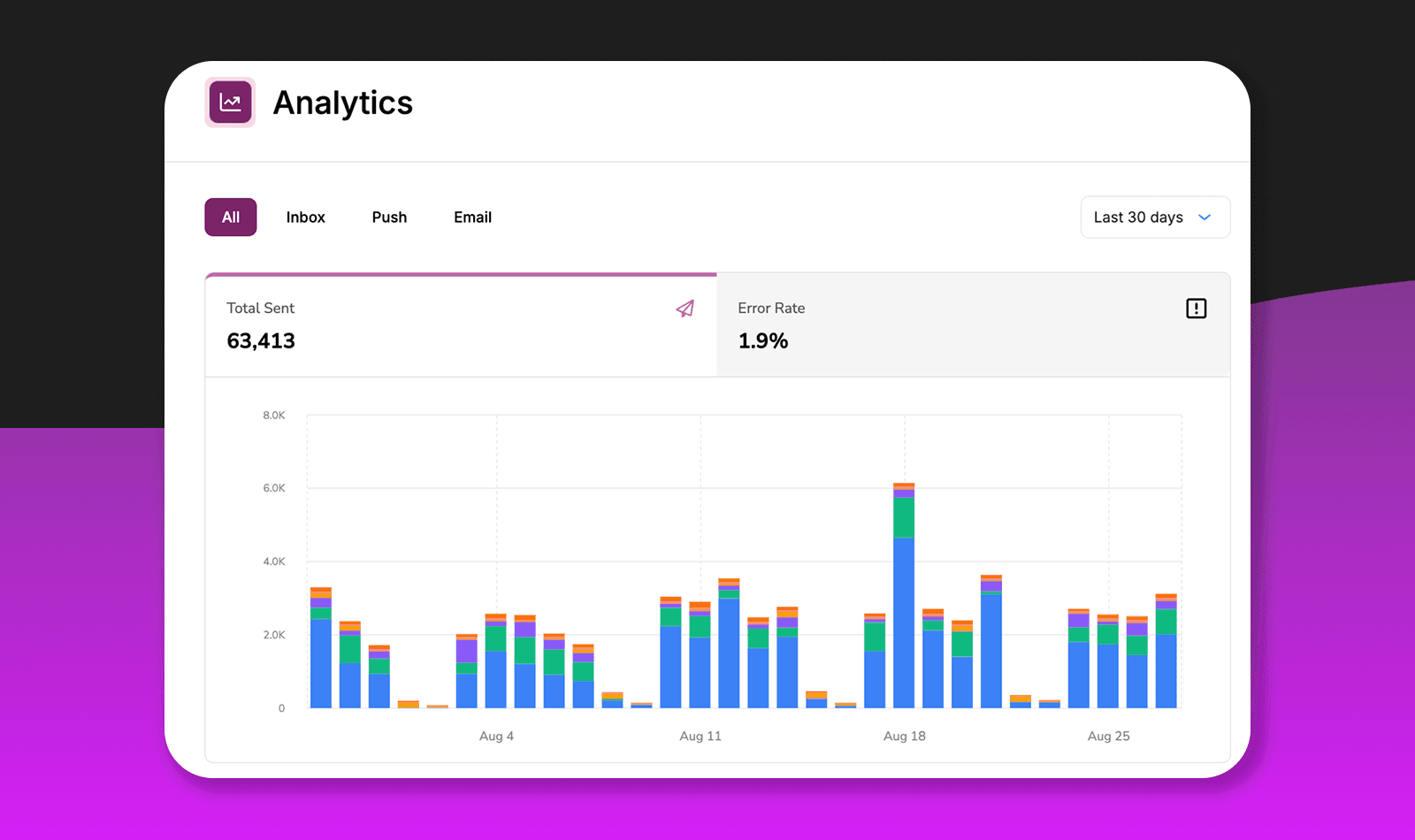
Courier's unified notification infrastructure provides the analytics foundation needed for sophisticated notification strategies. Track template effectiveness across channels, measure true business impact, and optimize based on data that matters for your specific business context and objectives.
The platform eliminates complexity from managing multiple notification providers and disparate analytics systems. Instead of piecing together data from Firebase, SendGrid, Twilio, and other providers, Courier provides one comprehensive dashboard with complete visibility into notification performance.
The most successful teams use notifications strategically, leveraging Courier's cross-channel insights to deliver the right message through the optimal channel at precisely the right time. This approach drives measurable business results rather than just engagement metrics.
Interested in getting a walkthrough of our platform from an engineer? Fill out this 1-step form.
Otherwise, send your first notification in minutes by setting up your workspace for free.
Case Study: Bluecrew's Multi-Channel Analytics Success
Bluecrew, a leading Workforce-as-a-Service platform, faced the challenge of managing notifications across email, SMS, in-app messages, and Slack as their two-sided marketplace expanded rapidly. Their previous approach required constant engineering resources for minor notification updates, creating bottlenecks that impacted their ability to communicate effectively with both employers and workers.
After implementing Courier's unified notification platform, Bluecrew achieved a 55% improvement in job application rates. The key breakthrough was gaining comprehensive visibility into which notification templates and channels drove the most meaningful engagement across their diverse user base.
"The analytics showed us that our SMS notifications were driving significantly higher response rates for shift reminders, while email worked better for detailed job descriptions," explains their team. "Having all this data in one dashboard instead of piecing together metrics from multiple providers was transformational for our strategy."
Courier's template-level analytics enabled Bluecrew to optimize their entire communication approach, moving from guesswork to data-driven decisions about when, how, and through which channels to reach their community most effectively.
Frequently Asked Questions
What's the difference between push notification open rates and conversion rates?
Open rates measure the percentage of users who tap on push notifications, while conversion rates track users who complete desired business actions after receiving notifications. Conversion rates provide better insight into business impact because they measure actual outcomes rather than just engagement behaviors.
For business applications, many users consume notification content without opening the notification itself, making conversion tracking more valuable for measuring success.
How long should attribution windows be for push notification conversions?
Attribution windows for push notifications should typically extend 7-30 days, significantly longer than traditional marketing channels. Business decision-making cycles often take weeks, especially for enterprise applications.
Courier's analytics support flexible attribution windows, allowing you to track conversions that occur days or weeks after notification delivery to capture the full business impact.
Which push notification metrics matter most for business applications?
The most important metrics for business applications are:
- Delivery rates
- Ensure critical communications reach users
- Conversion rates
- Measure actual business outcomes
- Template performance across channels
- Optimize message placement
- User journey progression
- Track workflow completion
- Business outcome correlation
- Connect notifications to revenue
Traditional engagement metrics like open rates provide less business value for enterprise applications.
How does Courier track notifications across multiple channels?
Courier provides unified analytics across push, email, SMS, and in-app channels in a single dashboard. The platform normalizes metrics across different providers and platforms, giving you consistent visibility into template performance regardless of which channels or providers you use.
This unified approach eliminates the need to piece together data from multiple provider dashboards and analytics systems.
Can push notifications influence conversions without being opened?
Yes, push notifications frequently influence user behavior and business outcomes without being directly opened. Users often consume notification content through preview text and make decisions based on that information.
Courier's analytics track influenced behaviors and downstream conversions, even when users never technically "open" the push notification itself, providing more accurate measurement of business impact.
What's the best way to measure push notification ROI?
Measure push notification ROI by connecting notification delivery to specific business outcomes:
- Track conversion events that occur after notification delivery
- Calculate customer lifetime value increases from notification engagement
- Monitor churn reduction from proactive communications
- Measure workflow efficiency improvements from status updates
- Connect to revenue attribution through your analytics platform
Courier's Segment integration makes this tracking straightforward by automatically sending notification events to your existing analytics infrastructure.
Ready to See Your Real Notification Impact?
Stop measuring push notifications with outdated metrics that miss business impact. Talk to a Courier Solutions Engineer who can show you exactly how your notifications perform across every channel and connect to actual business outcomes.
Get a Custom Demo of Courier's Analytics Platform
What's your biggest notification measurement challenge? We'll customize the demo to solve your specific analytics needs and show you how to track what truly drives business growth.
Similar resources

Courier vs Customer.io: 2026 messaging platform comparison
Courier and Customer.io both send across email, push, SMS, and in-app, but they are not priced or built the same way. Courier bills by the send, puts journeys, experiments, broadcasts, an in-app inbox, preferences, and 50+ delivery providers on one platform, and exposes all of it through an API, a CLI, and an MCP server. Customer.io bills by the number of profiles in your database and fits a marketing team that needs deep behavioral segmentation. This comparison covers pricing, journeys, channels, in-app messaging, localization, and preferences, with every competitor figure linked to Customer.io's own pages.

Your notification analytics are now available by API
If it's in the Courier dashboard, it's on the API. Analytics was one of the last screens where that wasn't true. GET /notifications/{id}/metrics returns sends, deliveries, opens, clicks, errors, and undeliverable counts per template as a time series, broken out by provider and channel, so the numbers can live in your own product or go straight to an agent.

Top 11 push notification platforms compared for 2026
Push starts as the whole job, then product wants an email fallback, legal wants a preference center, and support wants a searchable log. This guide compares 11 push notification platforms on channels, free tiers, and pricing, and shows why Courier's single API for push, email, SMS, in-app inbox, Slack, and Microsoft Teams fits that arc better than a push-only tool. Includes 2026 opt-in and open-rate benchmarks, a full-stack cost comparison, and what each platform leaves you to build.