Chapter 4
Customer journey patterns and best practices
Production blueprints for trial conversion, churn prevention, feature adoption, expansion, and enterprise onboarding, plus the frequency caps and cancellation rules that keep them from becoming noise.
Last updated: September 2026
Key takeaways
- A journey's length should match the lifecycle phase and the signals available, not a fixed calendar; a four-step journey that reacts to behavior beats a twelve-step one that fires regardless.
- The highest-value branches happen after you have enough behavioral data to route confidently, usually a few days in.
- Cancel a journey the moment its goal is met, so you stop messaging someone who already converted.
- The same patterns adapt across SaaS, healthcare, HR tech, and marketplaces by changing the channels, data, and constraints, not the structure.
Each blueprint is built from the nodes in Chapter 2.
Trial conversion
The trial-to-paid journey is where most product-led growth investment concentrates. The goal is helping users reach the activation milestones that predict conversion before the trial ends.
| Day | Trigger or check | Action |
|---|---|---|
| 0 | trial_started | Welcome message, personalized by {{data.use_case}} |
| 1 | Logged in? | If no, a login reminder via push or SMS |
| 3 | Feature activated? | Yes: next-step tips. No: getting-started help |
| 5 | Team invited? | If no, an invitation prompt with team value |
| 7 | Fetch engagement score | High: expansion talk plus a sales Slack alert. Medium: usage tips. Low: CS outreach |
| 13 | Final day | Conversion message, tailored to engagement level |
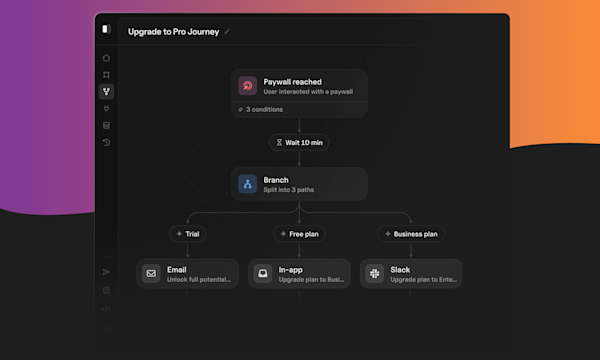
The branches at day 3 and day 7 are where behavior-driven journeys beat static sequences: by day 7 the journey has enough data to route confidently. When a user converts before the trial ends, cancel the run using the runId from the original invocation and start a post-conversion onboarding journey instead.
Churn prevention
Churn prevention journeys spot at-risk accounts before they cancel and route each to the right intervention. The most reliable early signals are engagement drops, not stated intent to leave.
Define risk tiers from behavioral data, then let the AI node score each account and return a level plus a one-line reason:
[Trigger: daily_risk_check]-> AI node: score churn risk -> { risk_level, reason }-> Branch on data.risk_levelhigh -> CS Slack alert + outreach task -> wait 3 days -> escalate if no contactmedium -> usage tips with the reason -> wait 7 days -> re-checklow -> feature discovery -> wait 14 days -> re-check
The reason field makes outreach feel specific instead of automated, and no scoring model has to be built or hosted. Cancel the journey when the account upgrades, when CS marks it contacted, or when usage recovers; running a churn journey at an active user creates friction.
Feature adoption
New features often launch with one announcement and no follow-through. Adoption journeys deliver education at the moment a user hits the relevant context. "You can export your data" three days after signup is noise if the user has no data yet; the same message when they create their first report and try to share it is useful.
Structure adoption journeys around context signals: a user reaches a milestone that makes the feature relevant, or activates a related feature that usually precedes it, with a time-based fallback only for users who never hit the trigger. Track the feature_activated event to measure what share of recipients actually adopted the feature inside the journey window, which separates adoption that works from clicks that go nowhere.
Expansion and upsell
Expansion journeys watch for growth signals and route each to the right conversation.
For per-seat pricing, monitor seat fill rate. When an account reaches 80% of its limit, a seat_utilization_update event triggers the journey: it messages the account owner with current utilization and the upgrade path, alerts the CSM, and starts a seven-day follow-up. A branch first checks whether an expansion conversation happened in the last 30 days, so accounts already in one are suppressed rather than messaged again. Don't wait for 100%: accounts that hit the wall without a conversation tend to churn.
Advanced-feature usage is another expansion signal. When an account activates multiple advanced features, send a message about the capabilities they're approaching that need a plan upgrade, framed around what they're trying to do, not upsell pressure.
Enterprise onboarding
Enterprise accounts need coordinated onboarding across stakeholders who each need different information. Map contacts to roles at setup and run a timeline per role:
- Technical contact: integration guides, API docs, SSO setup.
- Administrator: user management, policy and security configuration.
- Executive sponsor: success metrics, business case, QBR scheduling.
- End users: feature tutorials, quick-start guides, training schedules.
Track technical milestones (SSO configured, first integration live, provisioning set up) as product events, and have journey steps check milestone completion before advancing. Incomplete milestones past a deadline escalate to the CSM. Courier's tenant architecture keeps each enterprise customer's configuration isolated while the journey logic stays shared.
Patterns by industry
The structure holds across industries; the channels, data, and constraints change.
SaaS
B2B SaaS trial onboarding follows the trial conversion blueprint above. The differentiator is routing on product usage: developer-focused users get API and SDK docs, dashboard users get UI walkthroughs, driven by a feature_type property on the same feature_activated event.
Healthcare
Healthcare platforms face HIPAA constraints: no protected health information in email or SMS, yet patients need timely reminders. The pattern is channel separation enforced at the journey level. Appointment reminders escalate across channels (email with prep instructions at day 7, an SMS confirmation at day 3, a final reminder at day 1), and lab results branch on sensitivity: normal results send with a portal link, abnormal results notify the provider first. In-app messages can carry detail because the app requires authentication. Trusted Health coordinates staffing across hospital systems on this pattern, keeping sensitive details in authenticated in-app delivery and using email for the rest.
HR tech
HR platforms serve many companies with different policies and channel preferences. Tenant-based routing defines the journey once and respects each company's setup through group associations. New-hire onboarding, benefits enrollment with reminders at 14, 7, and 1 day before a deadline, and performance-review cycles all run as journeys that batch reminders into digests and use send windows so nothing lands outside working hours. Lattice runs this pattern for its performance-review cycles.
Marketplaces
Marketplaces coordinate parties with competing needs. The same order_placed event splits into a buyer path (email confirmations, tracking, delivery) and a seller path (push for immediate awareness, detailed emails, payout confirmations), with disputes escalating to support when an SLA approaches. High-volume sellers get throttling so updates arrive at a manageable frequency. Side coordinates real estate transaction milestones between agents and clients on this multi-party pattern.
Running journeys in production
Users are never in one journey at a time, so coordination is what keeps a good journey from becoming noise.
- Frequency caps. Send Limits set a cross-journey cap (for example, five messages a day) so a user in onboarding, a re-engagement journey, and an announcement doesn't get all three at once. Cap globally, per user, per user per subscription topic, or per tenant, over an hour, day, week, month, or billing period. When a message would push a counter over its limit, Courier blocks that message and logs it as
THROTTLEDrather than queuing it for later, so exempt the topics that must always get through using limit exclusions. Send Limits are available on the Business and Enterprise plans. - Cancellation. End obsolete journeys when a user hits a milestone. Canceling by cancellation token stops a group of related runs at once, across journeys, like every trial journey running for an account that just converted.
- Priority. Decide what outranks what, then encode it: system alerts above feature highlights, support updates above marketing. Nothing infers priority for you, so the ordering lives in your topic design and your limit exclusions.
- Preferences and timing. Group messages into topics users opt into per channel, and default critical topics to opt-in and marketing to opt-out. For quiet hours, put a send window on the routine send nodes so they wait for working hours in the recipient's timezone, and leave it off the ones that have to go out the moment they fire. Because the window sits on the node and not the workspace, one journey can hold its nudges until morning and still page someone immediately when something breaks.
- Personalization. Use Handlebars with profile and event data (
Hi {{profile.first_name}},activating {{data.feature_name}}) so one template serves many segments. Every trait sent through Segment'sidentifycall becomes a variable.
Frequently asked questions
How many steps should a customer journey have?
Match the length to the lifecycle phase and the signals you have. Trial onboarding usually spans 7 to 14 days with three to eight touchpoints depending on engagement; post-purchase sequences often run 30 to 90 days. Add a step only when it serves a goal based on real behavior. A four-step journey that reacts to signals outperforms a twelve-step one that fires regardless.
How do you measure whether a journey is working?
Track completion rate (the share of users who reach the goal event) and drop-off points (which steps see the highest exits), then compare the paths of converted and non-converted users to see where they diverge. Courier's message logs show delivery, open, and click data per step, and GET /journeys/runs pulls run history programmatically with a 95-day retention window. Layer that on product analytics that track the goal event. When you want to know whether different copy would do better, run an experiment on the send node instead of guessing: weighted variants, sticky per-recipient assignment, and metrics per variant. A journey that generates clicks but no feature activations is measuring the wrong thing.
How do you prevent a user from getting the same journey twice?
Check whether the user already completed the goal before starting the journey, for instance whether they're already on a paid plan or already activated the feature. Cancellation handles the case where the goal is met mid-journey, and frequency throttling prevents re-entry within a defined window even if the trigger fires again.
How many journeys can run for one user at once?
There's no hard per-user limit, but a user in more than three or four active journeys is probably getting more messages than any single journey would send. Set cross-journey Send Limits so total volume per user stays bounded. Once a counter is at its limit, the next message is blocked and logged as THROTTLED, so put the topics that must always arrive on the limit's exclusion list.
What should a journey do when a user ignores every message?
After a set number of sends with no engagement, drop to a low-frequency maintenance mode instead of continuing the cadence. For a trial user who hasn't opened anything by day 7, send one final message at day 13 rather than the full mid-journey sequence. For an unresponsive churn-risk account, route to CS for direct contact. Continuing to send to disengaged users hurts deliverability and adds no value.
Ship customer journeys with Courier
Building this yourself means event consumers, a workflow engine, delay queues, conditional evaluation, multi-channel dispatch, preference management, analytics, and now AI, before you send a single message. Courier handles that layer, so you design the flow and ship changes without a deploy while keeping one integration point in your code.
Ready to build customer journeys that respond to what users actually do? Talk to a solutions expert or get started for free with 10,000 sends a month.
Related resources: