Transactional, Product, and Marketing Notifications: What Are the Differences?
 Kyle SeylerOctober 23, 2025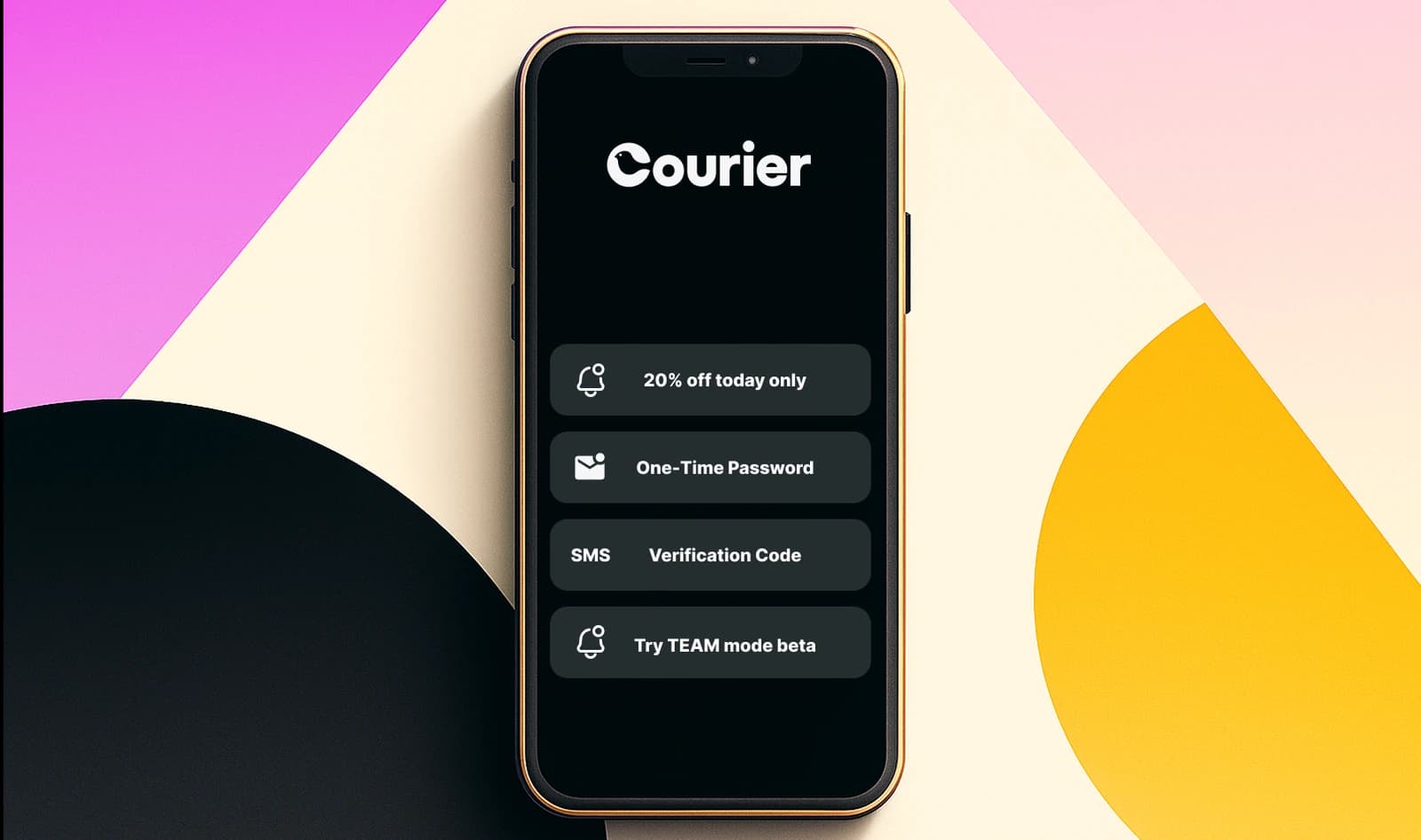
Transactional, product, and marketing notifications are specialized message types used for communicating with users across modern applications. As developers and product teams, understanding these notification types is essential to build effective user experiences and meet legal requirements.
In this article, I'll introduce transactional, product, and marketing notifications, and discuss their purposes, similarities, and differences to give you a better understanding. Whether you're using Courier or another notification platform, getting these fundamentals right is critical for compliance and user trust.
Understanding Transactional Notifications
What Are Transactional Notifications?
Transactional notifications are automated messages triggered by specific user actions or system events. These notifications provide essential information that users expect and need about their account activity or transactions.
Transactional notifications are not limited to financial transactions. The term refers to any notification that confirms or updates users about an action they initiated or an event affecting their account. Common examples include password resets, order confirmations, payment receipts, security alerts, API key generation, subscription renewals, appointment confirmations, and invoice notifications.
How Do Transactional Notifications Work
The transactional notification workflow consists of 4 steps:
- A user action or system event triggers the notification.
- The system generates a message with relevant transaction details.
- The message is sent through appropriate channels (email, SMS, push) to the user.
- The user receives critical information they need to take action or stay informed.
These notifications are sent in real-time or near real-time to ensure users receive updates when they need them most. For example, when you reset your password, the system immediately sends a verification email. When a payment fails, you get an alert within seconds so you can update your payment method.
Advantages of Transactional Notifications
- High open rates because users expect and need this information.
- Build trust by keeping users informed about critical account activities.
- Reduce support inquiries by proactively providing status updates.
- Can be sent without explicit opt-in since they're necessary for service delivery, per FTC CAN-SPAM guidelines.
- Prioritized by email providers for inbox delivery over promotional messages.
Disadvantages of Transactional Notifications
- Must be sent through reliable infrastructure to avoid failures of critical messages.
- Cannot include promotional content in most jurisdictions due to legal requirements under FTC CAN-SPAM guidelines.
- If poorly designed or too frequent, can create notification overload for active users.
- Require careful error handling and monitoring to ensure delivery.
- Adding any promotional content can reclassify them as marketing messages requiring opt-in.
Understanding Product Notifications
What Are Product Notifications?
Product notifications (also called lifecycle or engagement notifications) are messages designed to help users understand, adopt, and get value from your product. These notifications are educational and feature-focused, guiding users through the product experience.
Unlike transactional notifications that respond to user actions, product notifications proactively drive engagement by introducing new features, providing usage tips, and helping users discover functionality they might otherwise miss. Common examples include new feature announcements, onboarding guidance, usage tips, milestone celebrations, and feature discovery prompts.
How Do Product Notifications Work
Product notifications are typically triggered by user behavior patterns, product events, or time-based rules:
- The system tracks user behavior and engagement metrics.
- Based on predefined rules, the system identifies opportunities to guide users.
- Targeted messages are delivered through in-app UI, push notifications, or email.
- Users learn about features and functionality that match their usage patterns.
For example, if a user hasn't activated a key feature after 7 days, the system might send a tooltip or modal explaining its value. When you ship a major feature update, you announce it through in-app banners to all relevant users.
Advantages of Product Notifications
- Drive feature adoption significantly when done well.
- Reduce time-to-value by guiding users to relevant features faster.
- Increase retention by helping users discover the full value of your product.
- Can be highly personalized based on user segments and behavior.
- Delivered in-app where users are actively engaged with your product.
Disadvantages of Product Notifications
- Can cause notification fatigue if overused or poorly targeted.
- Require sophisticated segmentation to avoid showing irrelevant features.
- Need careful timing to avoid interrupting user workflows.
- Effectiveness depends heavily on quality of messaging and targeting.
- Measuring impact on actual feature adoption requires proper analytics instrumentation.
Understanding Marketing Notifications
What Are Marketing Notifications?
Marketing notifications (also called promotional notifications) are messages designed to drive sales, conversions, or business growth through promotional campaigns. These notifications highlight offers, discounts, events, and opportunities that encourage users to take commercial actions.
Marketing notifications always require explicit user opt-in and must include unsubscribe options per FTC CAN-SPAM requirements. They're typically sent to broad segments of users rather than being triggered by individual user actions. Common examples include sale announcements, discount codes, webinar invitations, newsletter content, upgrade promotions, and seasonal campaigns.
How Do Marketing Notifications Work
Marketing notifications follow a campaign-based workflow:
- Marketing teams plan campaigns around business goals (sales, promotions, events).
- Messages are designed with promotional content and calls-to-action.
- User segments are selected based on targeting criteria.
- Notifications are scheduled and sent through selected channels.
- Results are measured against conversion and engagement metrics.
These notifications can be one-time broadcasts or part of automated marketing sequences. For example, a sale notification goes to all opted-in users, while an abandoned cart reminder is triggered by specific user behavior but still promotional in nature.
Advantages of Marketing Notifications
- Direct path to drive revenue and conversions.
- Can create urgency with time-limited offers.
- Enable A/B testing to optimize messaging and conversion rates.
- Allow businesses to re-engage dormant users with incentives.
Disadvantages of Marketing Notifications
- Lower engagement compared to transactional notifications.
- Require explicit opt-in, limiting reach to consenting users.
- Can damage sender reputation if perceived as spam.
- Risk of unsubscribes if frequency is too high or content isn't valuable.
- Poor performing marketing can hurt deliverability of all your messages if not properly separated.
Differences Between Transactional, Product, and Marketing Notifications
Transactional VS Product
- Transactional notifications are triggered by user actions, while product notifications are triggered by usage patterns or product events.
- Transactional notifications confirm what happened, while product notifications guide users on what to do next.
- Transactional notifications are reactive (responding to events), while product notifications are proactive (driving engagement).
- Transactional notifications require no opt-in, while product notifications typically do depending on the channel.
- Transactional notifications are managed by engineering teams, while product notifications are managed by product teams.
Transactional VS Marketing
- Transactional notifications provide essential service information, while marketing notifications promote commercial offers.
- Transactional notifications must be sent without promotional content, while marketing notifications focus entirely on promotion.
- Transactional notifications have legal exemptions from opt-in requirements, while marketing notifications always require consent.
- Transactional notifications are sent 1:1 in response to individual actions, while marketing notifications are broadcast to segments.
- Transactional notifications have higher open rates, while marketing notifications typically see lower engagement.
Product VS Marketing
- Product notifications educate users about features, while marketing notifications promote offers and sales.
- Product notifications aim to increase product adoption and usage, while marketing notifications aim to drive conversions and revenue.
- Product notifications are managed by product teams, while marketing notifications are managed by marketing teams.
- Product notifications are personalized based on user behavior in the product, while marketing notifications are segmented based on broader marketing criteria.
- Product notifications often appear in-app, while marketing notifications typically use email and SMS channels.
Frequently Asked Questions
Do I need separate infrastructure for each notification type?
Yes, it's highly recommended. Separating transactional and marketing email through multi-tenant infrastructure prevents poor marketing performance from affecting delivery of your critical transactional messages. Many companies use separate IP addresses and subdomains for each type. Courier's transactional notification solution allows you to manage all three notification types with proper separation and routing.
Can I add a discount code to a password reset email?
No. According to the FTC, adding any promotional content to a transactional notification can reclassify it as a marketing message that requires opt-in. The FTC states that if "a recipient reasonably interpreting the subject line would likely conclude that the message contains an advertisement" or if "the transactional or relationship content does not appear, in whole or in substantial part, at the beginning of the body of the message," it becomes a commercial message. Keep transactional notifications purely informational.
Are abandoned cart notifications transactional or marketing?
It depends on the content. A notification that says "Your cart expires in 24 hours" without promotional elements could be considered transactional (informing about system behavior). However, "Complete your purchase and save 15%" is clearly marketing since the primary purpose is commercial advertisement, which requires opt-in under CAN-SPAM.
Do in-app product notifications require opt-in?
Generally no for tooltips, modals, and banners that are part of the product interface. However, mobile push notifications typically do require explicit opt-in, even when they're announcing product features rather than promotions. Building an in-app notification center gives users control over their preferences without requiring separate opt-in for each message type.
How do I know if my notification is product or marketing?
Ask yourself: "Is the primary goal to help the user use a feature they already have access to, or to convince them to buy something?" If it's education about existing functionality, it's product. If it's promoting an upgrade, sale, or conversion, it's marketing.
What's the best channel for each notification type?
Transactional: Email and SMS work well for most cases. SMS is preferred for time-sensitive items like two-factor authentication codes. Push notifications work for mobile-first applications. Courier's channel settings let you route each notification type through the optimal channel.
Product: In-app notifications (modals, tooltips, banners) are most effective since users are actively engaged. Email and push can supplement for users who aren't currently in the product.
Marketing: Email is the primary channel for most marketing campaigns. SMS and push require more careful use due to their intrusive nature and stricter opt-in requirements.
How can I get started with Courier?
Courier provides a unified platform for managing all three notification types with proper separation and compliance. You can read the documentation to learn more, or send test notifications to see how easy it is to get started with reliable, compliant notification infrastructure.
Conclusion
In this article, I introduced transactional, product, and marketing notifications with their purposes and compared them to each other. Transactional notifications are essential for service delivery and account updates. Product notifications drive feature adoption and engagement. Marketing notifications promote commercial offers and drive revenue. Understanding when to use each type is critical for building notification systems that users trust, engage with, and that comply with legal requirements.
Similar resources

HIPAA-compliant notifications: where PHI should live
A practical guide to HIPAA-compliant notifications across SMS, push, email, and an in-app inbox. One rule, applied to every channel and every place PHI gets stored, including the systems most teams forget are in scope.
How to get your logo in Gmail and Apple Mail
BIMI puts your logo next to your emails in Gmail and Apple Mail, but there is no upload form. It is earned by locking your domain down. Here is the whole project: what it costs, how long it takes, and the five ways it fails silently.

Email preview tools compared: 6 that render on real devices
Most "email preview" features are simulations. These six open your email in the actual client and send back a screenshot. Here’s what each costs per preview, how much work sits between your template and the result, and which ones you can drive from code.