Top 10 push notification providers in 2026
 Emily LaneJuly 06, 2026
Last updated: July 2026. Platform support, pricing models, and capabilities below were checked against each provider's own documentation on this date.
A push notification provider is any platform or service that delivers real-time alerts to a user's device or browser. In practice, "provider" covers three different layers that people lump together: the native transport rails that actually move a notification to a device (Apple Push Notification service and Firebase Cloud Messaging), higher-level engagement platforms that add segmentation and campaigns on top of those rails (OneSignal, Airship, Braze, CleverTap), and orchestration layers that route a single notification across push and every other channel with failover and preferences built in (Courier).
Picking one means being honest about which layer you actually need. If you only ship to Android, FCM is free and you are done. If you need cross-platform delivery with retries, analytics, and a way to reason about why a notification did or did not arrive, you are shopping at a different layer. This guide compares ten providers across all three, each measured against the same evaluation criteria and checked against its own documentation.
TLDR
Push providers span three layers: native transport rails like APNs and FCM (free, reach-focused), engagement platforms that add campaigns and a UI on top, and orchestration layers that route push as one channel among many with failover and preferences. If you need push delivered reliably alongside email, SMS, and in-app, Courier fits that last layer and bills per notification, not per channel.
Quick picks:
- Cross-channel orchestration with push, failover, and preferences: Courier
- Free, cross-platform transport rail (Android, iOS, web): Firebase Cloud Messaging
- Native iOS and Apple-device delivery: Apple Push Notification service
- React Native and Expo apps: Expo
- No-code push and marketing UI with a generous free tier: OneSignal
For a deeper look at the infrastructure layer specifically, read Best Ways to Build Notification Infrastructure in 2026.
The push notification problem
Sending one push notification is easy. Sending push at scale, across platforms, reliably, is where the work shows up.
The first problem is fragmentation. Android goes through FCM, Apple devices go through APNs, and web push uses yet another protocol. Each has its own credentials, payload rules, and failure modes. Wire them up directly and you are maintaining three integrations before you send a single notification.
The second problem is reliability. When a transport rail throttles you or a token goes stale, does your system retry, route around it, or silently drop the notification? Raw rails give you a delivery receipt at best. They do not tell you why a user never saw the alert.
The third problem is that push rarely travels alone. A password reset, an order update, or an incident alert often needs to reach someone by push, then fall back to email or SMS if the push fails. That is orchestration, and it lives above the transport layer. The gap between "a service that delivers push" and "infrastructure that gets the notification to the person" is where most evaluation mistakes happen.
Platform support at a glance
Support as documented by each provider (July 2026). A check means the target is natively supported.
| Provider | iOS | Android | Web push | Non-push channels | Provider abstraction |
|---|---|---|---|---|---|
| Courier | ✓ | ✓ | ✓ | ✓ | ✓ |
| Firebase Cloud Messaging | ✓ | ✓ | ✓ | ||
| Apple Push Notification service | ✓ | ✓ (Safari) | |||
| Amazon SNS | ✓ | ✓ | ✓ | ||
| Expo | ✓ | ✓ | |||
| OneSignal | ✓ | ✓ | ✓ | ✓ | |
| Airship | ✓ | ✓ | ✓ | ✓ | |
| Braze | ✓ | ✓ | ✓ | ✓ | |
| CleverTap | ✓ | ✓ | ✓ | ✓ | |
| Pushwoosh | ✓ | ✓ | ✓ | ✓ |
Courier delivers push through your choice of provider (FCM, APNs, Expo, OneSignal, Amazon SNS, Airship, and more) and routes the same notification across email, SMS, in-app inbox, Slack, Microsoft Teams, and WhatsApp when you need it.
The top push notification providers in 2026
1. Courier
Courier is notification infrastructure for developers. Instead of being a single push rail, it sits above them: you send one API call, and Courier delivers push through the provider you choose (FCM, APNs, Expo, OneSignal, Amazon SNS, Airship, and others), with automatic failover when a provider has an outage. The same notification can also route to email, SMS, in-app inbox, Slack, Microsoft Teams, or WhatsApp, and every routing decision is visible in logs.
The framing matters: you are not wiring three transport rails and a retry queue by hand. You are building notification delivery into your product with preferences and observability included.
Platform reach
iOS, Android, and web push through integrated providers, plus email, SMS, in-app inbox, Slack, Microsoft Teams, and WhatsApp. The broadest reach in this comparison.
Best for
Teams that want push delivered reliably as part of a cross-channel system: provider failover, user preferences with audit trails, delivery logs, and a drop-in in-app inbox, all from one API.
Pros
- Provider abstraction with failover. Swap FCM for Expo, or add a fallback, without changing your code. If a provider goes down, Courier routes around it.
- Push plus every other channel. One send fans out to push, email, SMS, in-app, Slack, Teams, and WhatsApp, so a notification that must reach someone can fall back across channels.
- Preference management with audit trails. Verify what a user opted into, on which channel, and when it changed.
- Routing visibility in logs. Trace why a notification did or did not reach a device instead of guessing.
- Pay-as-you-go pricing. Billed per notification, not per channel, with a free tier of 10,000 notifications per month.
- The widest set of AI coding tools in the category. MCP integration, a CLI, agent skills, and 14 SDKs let you build from Cursor, Claude Code, or VS Code.
Connecting Courier to an AI editor takes one line:
claude mcp add --transport http courier https://mcp.courier.com --header api_key:XXXX
(See the MCP docs for Cursor and VS Code setup.)
Cons
- Not a raw transport rail. Courier orchestrates delivery through providers like FCM and APNs rather than being the rail itself, so if you truly only need Android push and nothing else, FCM alone is simpler.
- Not a campaign-marketing suite. Courier does not include send-time optimization; if B2C push marketing campaigns are your primary need, OneSignal or Airship are built for that.
Pricing
Free up to 10,000 notifications per month, then pay-as-you-go per notification across any number of channels. Contact the solutions team for enterprise options.
2. Firebase Cloud Messaging (FCM)
Firebase Cloud Messaging is Google's free, cross-platform push service and the canonical transport rail for Android. It also delivers to iOS (through APNs under the hood) and to web apps via the Web Push protocol. It supports topic subscriptions, message priority levels, and rich media payloads.
Works with Courier. Courier delivers push through FCM as a provider, so you keep FCM as your Android and cross-platform rail and add email, SMS, in-app, Slack, and more, with automatic failover, from the same API call.
Platform reach
iOS, Android, and web.
Best for
Teams that want a free, reliable transport rail, especially anyone shipping to Android.
Pros
- Completely free. No per-message charges and no documented message-count limit on either the Spark or Blaze plan.
- Reliable Google infrastructure. Backed by the same platform that powers Android push.
- Cross-platform from one SDK. Android, iOS, and web through a single integration.
- Topic and priority controls. Topic subscriptions and priority levels cover common delivery patterns.
Cons
- Transport only. No cross-channel fallback, no preference center, and limited built-in orchestration beyond delivery.
- 4 KB payload limit. Messages are capped at roughly 4,096 bytes.
- Console UX and setup. Managing credentials and the Firebase Console adds overhead, especially for iOS.
Pricing
Free.
3. Apple Push Notification service (APNs)
Apple Push Notification service is Apple's native rail for delivering push to iPhone, iPad, Mac, Apple Watch, and Safari. It is the only way to reach Apple devices, and every higher-level provider that sends to iOS ultimately routes through it.
Works with Courier. Courier sends to Apple devices through APNs, so you keep APNs as your iOS rail and route the same notification across Android, web, email, SMS, in-app, and more, with failover, while Courier handles the tokens and certificates.
Platform reach
iOS, iPadOS, macOS, watchOS, and Safari web push.
Best for
Native Apple apps that want to talk to the rail directly with no abstraction.
Pros
- The source of truth for Apple devices. Direct, first-party delivery with no middle layer.
- Free. Apple does not charge to send through APNs.
- Rich notification support. Notification service extensions enable media attachments and content modification.
- Strong performance. APNs consistently posts low median response times in published benchmarks.
Cons
- Apple only. No Android or general web coverage; you still need a second rail for those.
- Token and certificate management. Provider authentication tokens and certificates add operational work.
- Delivery only. No segmentation, preferences, or cross-channel orchestration.
Pricing
Free.
4. Amazon SNS
Amazon Simple Notification Service is AWS's pub/sub messaging service, and mobile push is one of its delivery targets. It fans out messages to APNs, FCM, and other endpoints, and fits naturally into an AWS-heavy stack alongside SMS, email, and queue delivery.
Platform reach
iOS and Android push, plus SMS, email, and HTTP/queue endpoints.
Best for
Teams already on AWS that want high-throughput fan-out with push as one endpoint type.
Pros
- AWS-native. Integrates cleanly with Lambda, SQS, CloudWatch, and IAM.
- High throughput. Topic-based publish-subscribe handles large fan-out volumes.
- Low cost at scale. A generous free tier and inexpensive per-message pricing.
- Multiple endpoint types. Push, SMS, email, and queues from one service.
Cons
- Complex setup. Platform applications, endpoints, and IAM policies add configuration overhead.
- Bare-bones push features. No templates, segmentation, preference center, or delivery UI.
- Best inside AWS. The value drops if the rest of your stack lives elsewhere.
Pricing
The first 1 million mobile push notifications per month are free, then $0.50 per additional million.
5. Expo
Expo is a React Native framework with an integrated push service. It wraps FCM and APNs behind a single API and token format, so React Native teams can send cross-platform push without touching either native rail directly.
Works with Courier. Courier integrates with Expo, so a React Native team can keep Expo for push and add web, email, SMS, and in-app from one API, with failover to another provider when you need it.
Platform reach
iOS and Android (through FCM and APNs).
Best for
React Native and Expo teams that want push with minimal native setup.
Pros
- Simplified integration. One API and one token type across iOS and Android.
- No native push code required. Expo handles the FCM and APNs plumbing.
- Free push service. Expo does not charge per notification.
- Rich content and deep linking. Standard payload features are supported.
Cons
- Expo ecosystem dependency. Best suited to apps already built with Expo and React Native.
- No web push. Coverage is mobile only.
- Rate limits. The push service is capped at 600 notifications per second per project.
- Delivery only. No cross-channel orchestration or preference management.
Pricing
The Expo push service is free. You still need a free Firebase project for Android and an Apple Developer account for iOS; EAS Build and Update are separate paid products (from $19 per month plus usage).
6. OneSignal
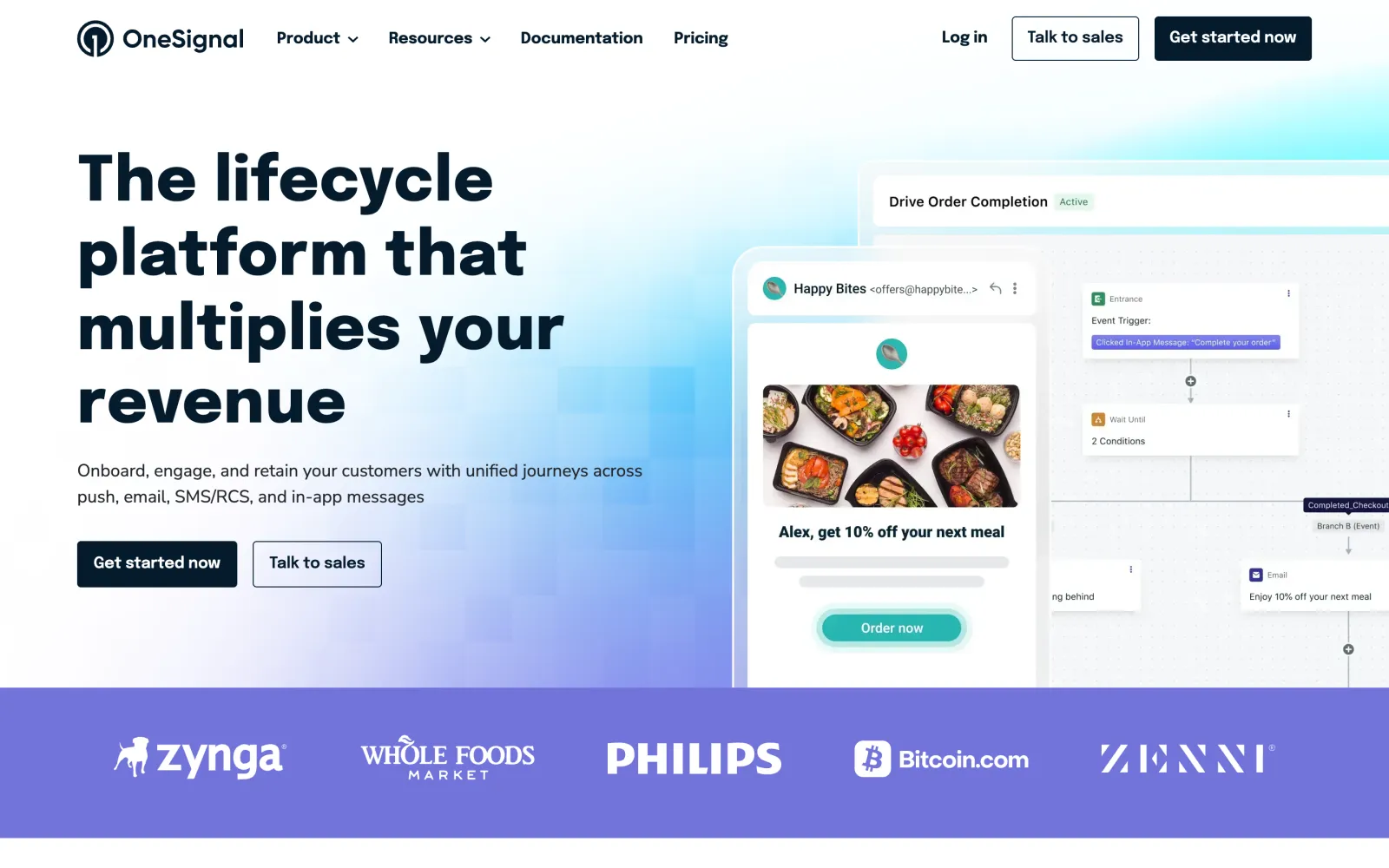
OneSignal is a widely adopted customer messaging platform with push at its center, aimed at product and marketing teams. It adds a visual template editor, segmentation, journeys, and A/B testing on top of push, plus email, SMS, and in-app channels.
Works with Courier. Courier sends push through OneSignal, so you keep OneSignal where it fits and add per-notification cross-channel routing, provider failover, and auditable preferences around it.
Platform reach
iOS, Android, and web push, plus email, SMS, and in-app.
Best for
Teams that want a no-code push and marketing UI with a generous free tier.
Pros
- Fast onboarding. A friendly UI gets non-engineers sending push quickly.
- Generous free tier. Unlimited mobile push sends on the free plan.
- Marketing tooling. Segmentation, journeys, and A/B testing built in.
- Multi-channel. Push, email, SMS, and in-app from one platform.
Cons
- Lighter transactional orchestration. Built more for campaigns than for reliable, per-event transactional routing with cross-channel fallback.
- Subscriber-based pricing. Paid push is billed per monthly active user, which can climb as your base grows.
- Provider abstraction is not the model. OneSignal is the sender, so you do not swap underlying rails or add failover the way an abstraction layer allows.
Pricing
Free plan with unlimited mobile push. The Growth plan starts at $19 per month plus usage, with mobile push billed at $0.012 per monthly active user.
7. Airship
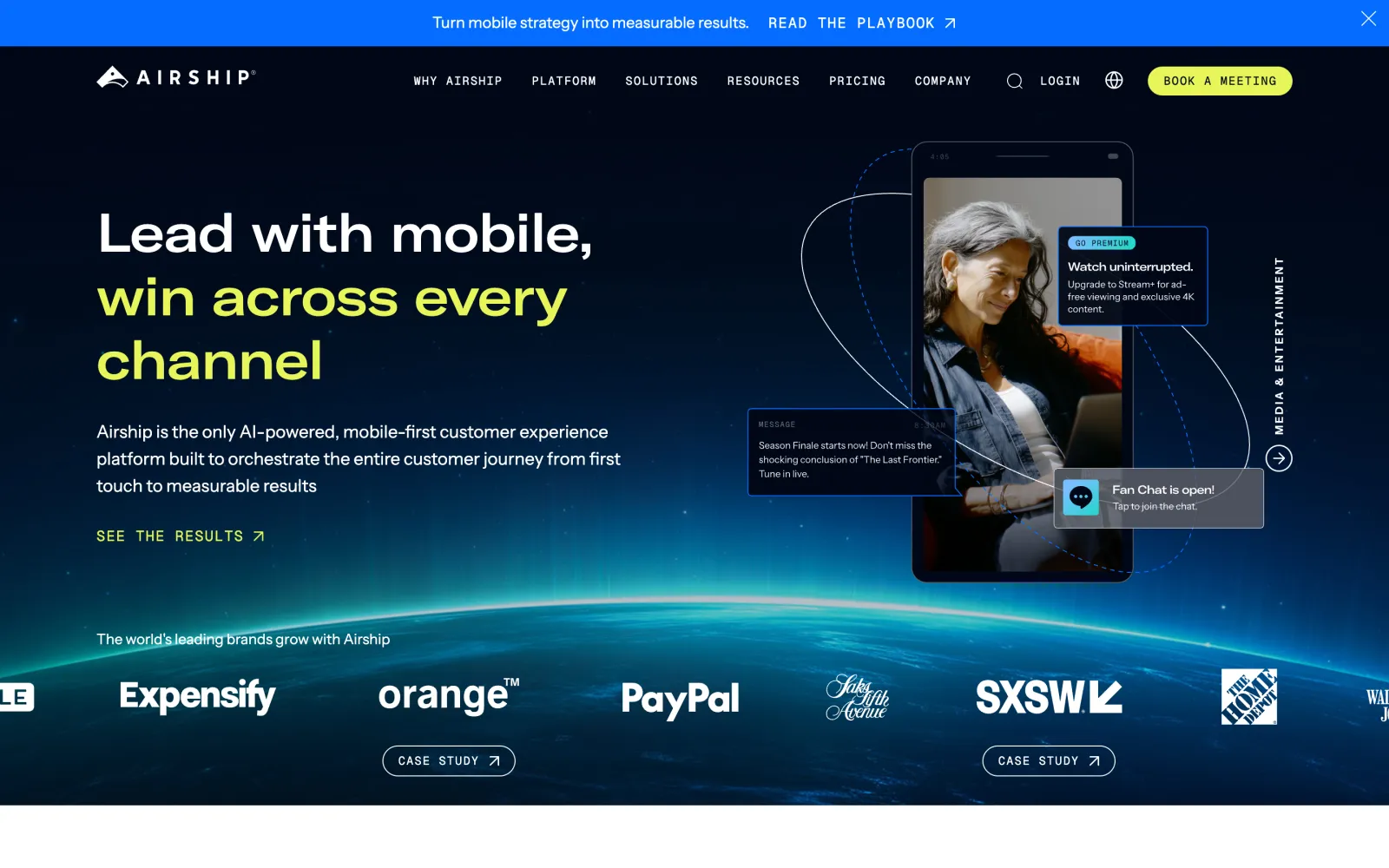
Airship is an enterprise customer engagement platform built around mobile push. It adds predictive segmentation, AI-powered journeys, in-app messaging, mobile wallet, SMS, and email on top of push, aimed at large B2C brands with mobile-first programs.
Works with Courier. Courier delivers push through Airship, so you keep Airship for enterprise mobile marketing and use Courier for developer-owned transactional notifications across push, email, SMS, in-app, and more.
Platform reach
iOS, Android, and web push, plus in-app, SMS, email, and mobile wallet.
Best for
Enterprise B2C teams running sophisticated mobile lifecycle and marketing programs.
Pros
- Deep segmentation and personalization. Predictive targeting and granular audience controls.
- AI-powered journeys. Customer journey orchestration across channels.
- Broad mobile feature set. Push, in-app, wallet, SMS, and email in one platform.
- Enterprise reporting. Mature analytics and benchmarking.
Cons
- Enterprise pricing. Quote-only, typically aimed at brands spending well into five figures per year.
- Marketing-first. Built for campaign teams more than for developer-owned transactional infrastructure.
- Heavier adoption. More platform to learn and configure than a raw rail or a lightweight tool.
Pricing
Custom, quote-only. No published rates and no free tier; commonly positioned for annual commitments in the tens of thousands.
8. Braze
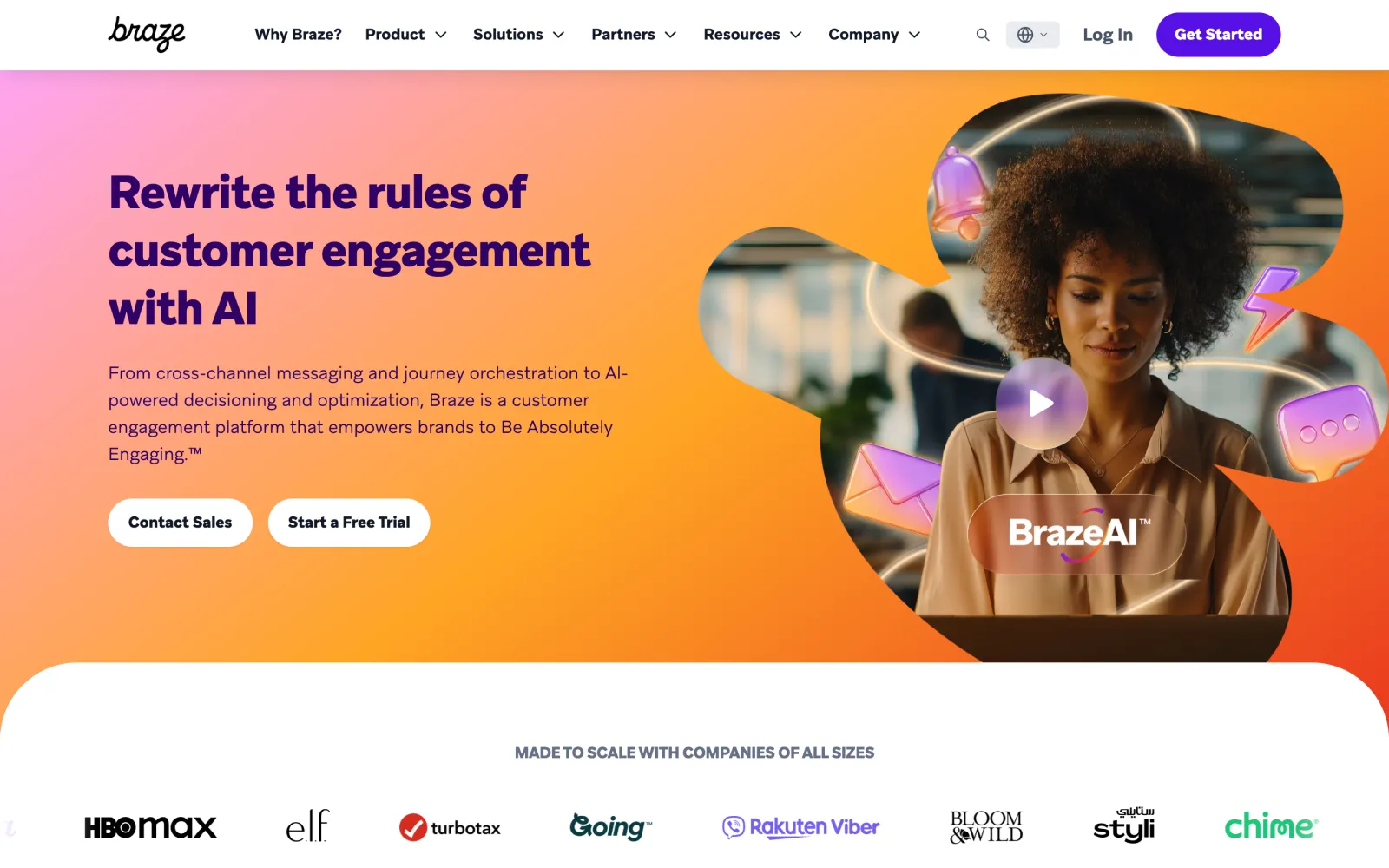
Braze is an enterprise customer engagement platform that combines cross-channel messaging with journey orchestration and AI-powered decisioning. Push is one channel in a wide set that also includes email, in-app, web push, SMS, RCS, WhatsApp, Content Cards, and regional channels like LINE and KakaoTalk.
Platform reach
iOS, Android, and web push, plus email, in-app, SMS, RCS, WhatsApp, and more.
Best for
Enterprise B2C teams running high-volume, cross-channel lifecycle and marketing programs.
Pros
- Canvas journey orchestration. A visual builder with branching, delays, and experimentation for lifecycle campaigns.
- Broad channel set. Push alongside email, SMS, RCS, WhatsApp, in-app, and Content Cards.
- AI-powered decisioning. Send-time, channel, and content optimization built in.
- Currents data streaming. Real-time engagement event export to analytics and warehouse partners.
Cons
- Enterprise pricing. Value-based and quote-only, typically a significant annual commitment.
- Marketing-first. Built for campaign teams more than for developer-owned transactional infrastructure.
- Heavier adoption. More platform to learn and configure than a raw rail or a lightweight push tool.
Pricing
Custom, quote-only. Braze uses value-based pricing tied to the channels, message volume, and AI features you use; enterprise deployments commonly run well into six figures per year.
9. CleverTap
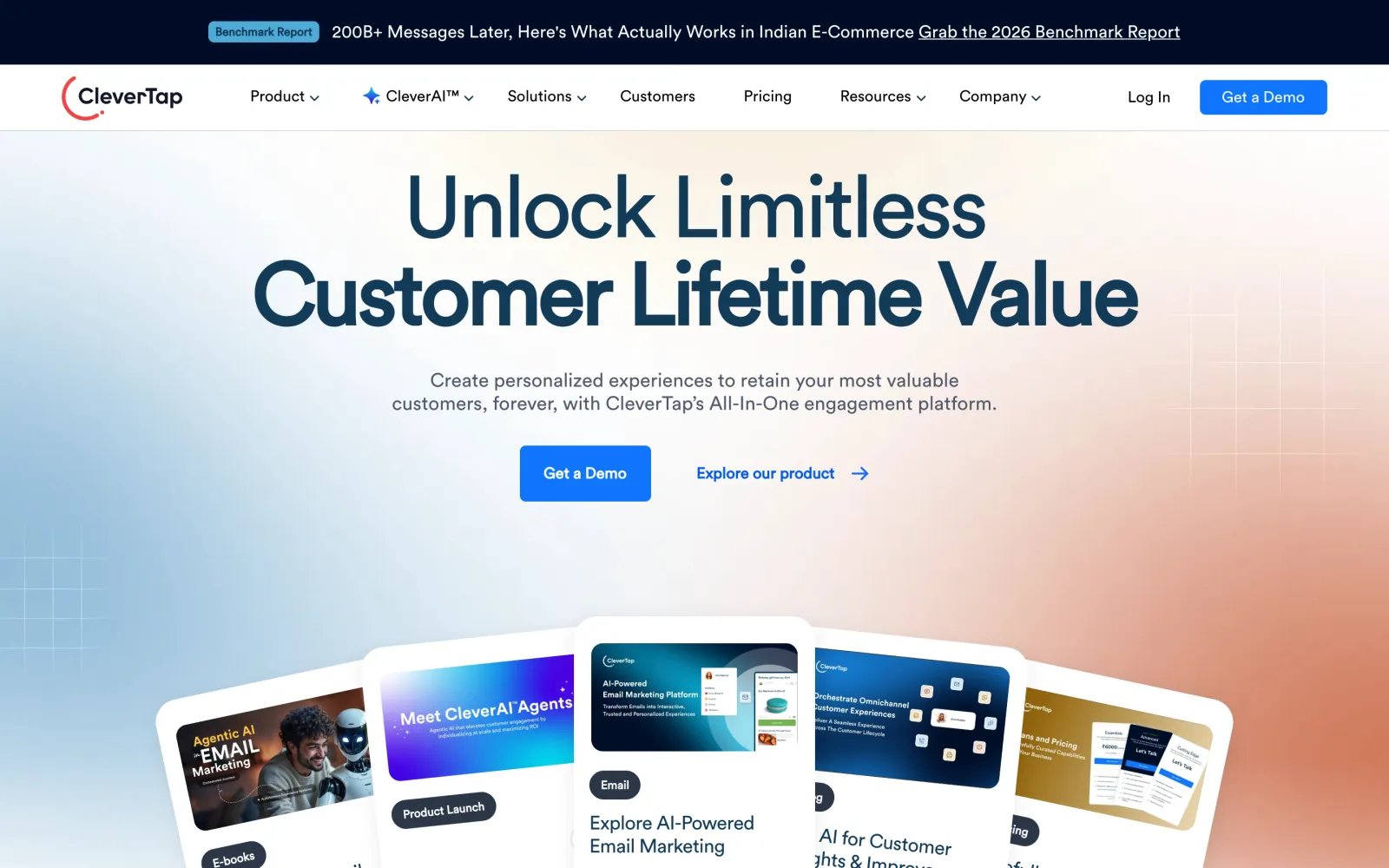
CleverTap is a mobile-first customer engagement and retention platform with push at the center and analytics as a core strength. It combines segmentation, journeys, and behavioral analytics across push, in-app, web push, email, WhatsApp, SMS, RCS, and an app inbox.
Platform reach
iOS, Android, and web push, plus in-app, email, WhatsApp, SMS, and app inbox.
Best for
Mobile teams that want engagement and lifecycle messaging tied to deep behavioral analytics.
Pros
- Analytics-led engagement. Behavioral segmentation and analytics inform targeting and journeys.
- Broad channel set. Push, in-app, web push, email, WhatsApp, SMS, and app inbox.
- AI and experimentation. Predictive segments, send-time optimization, and A/B testing.
- Mobile-first depth. Strong tooling for app onboarding, retention, and re-engagement.
Cons
- Marketing-first. Built for engagement teams rather than developer-owned transactional delivery.
- No permanent free tier. A time-limited trial and a startups program, but not an always-free plan like some rivals.
- Higher-tier pricing is opaque. Advanced tiers are quote-only.
Pricing
The Essentials plan starts around $75 per month for up to 5,000 monthly active users; Advanced and higher tiers are custom. A 14-day trial and a startups program (up to 100,000 MAU) are available, but there is no permanent free tier.
10. Pushwoosh
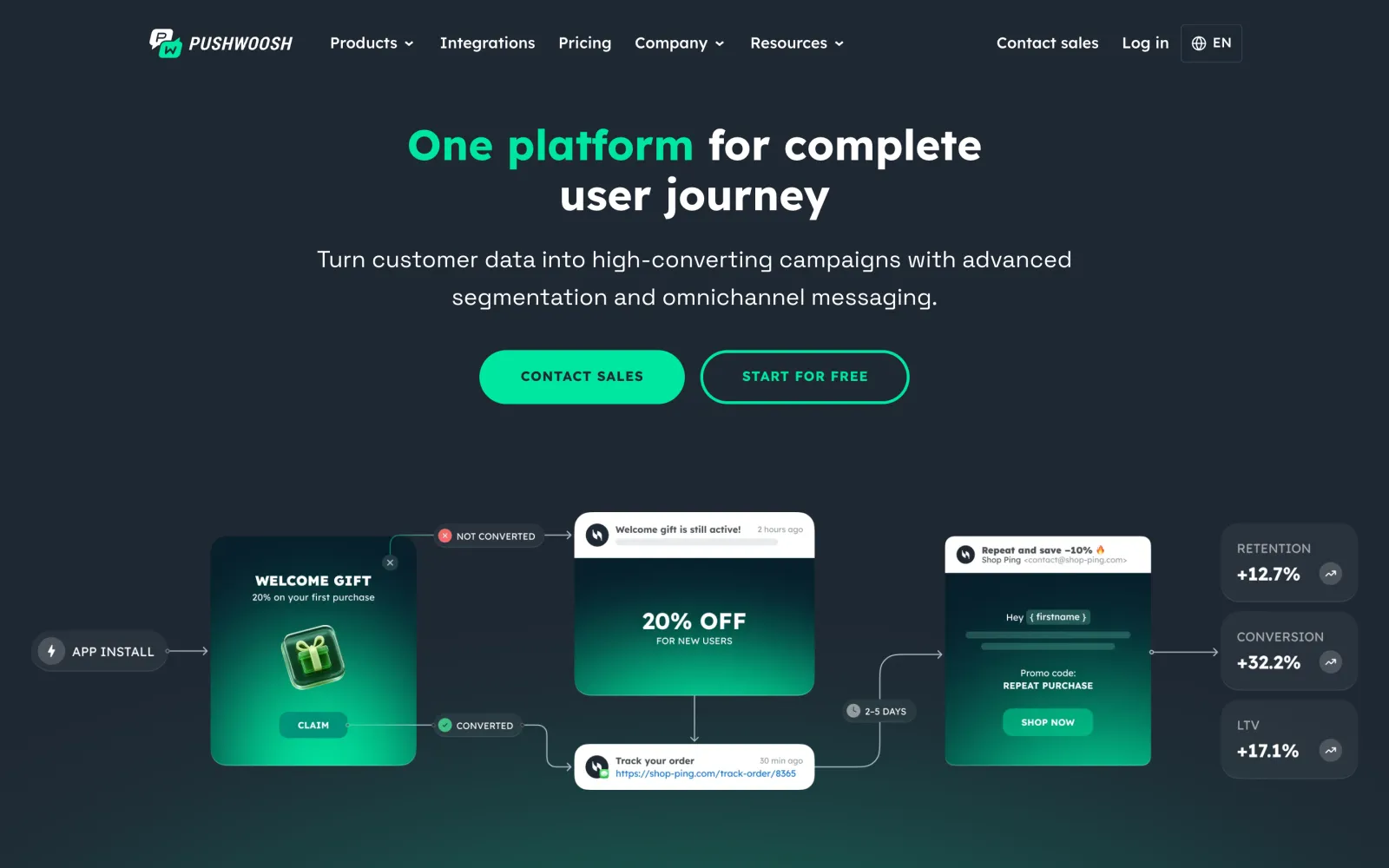
Pushwoosh is a dedicated cross-platform push and omnichannel messaging platform aimed at mid-market teams. Push is unlimited on every plan, with in-app messages, email, SMS, and WhatsApp available on omnichannel tiers, plus segmentation, journeys, and A/B testing.
Platform reach
iOS, Android, and web push, plus in-app, email, SMS, and WhatsApp.
Best for
Teams that want dedicated cross-platform push with predictable pricing and a real free tier.
Pros
- Unlimited push on every plan. Push and in-app messages are not metered per send.
- Free developer tier. Full platform access up to 1,000 monthly active users.
- Omnichannel add-ons. Email, SMS, and WhatsApp on paid tiers alongside push.
- Journeys and segmentation. Campaigns, segmentation, and A/B testing built in.
Cons
- MAU-based pricing. Omnichannel plans bill per 1,000 monthly active users, which scales with your base.
- Marketing-oriented. Built for campaigns more than developer-owned transactional infrastructure.
- Smaller ecosystem. Fewer SDKs and integrations than the largest platforms.
Pricing
Free Developer plan up to 1,000 monthly active users with unlimited push. The Omnichannel plan is around $13 per 1,000 monthly active users and includes push, in-app, email, SMS, and WhatsApp.
Comparison table
| Provider | Best for | Differentiator | Pricing model |
|---|---|---|---|
| Courier | Cross-channel orchestration with push | Provider failover, per-notification pricing, preferences, AI coding tools | Free 10,000 notifications/month, then pay-as-you-go per notification |
| Firebase Cloud Messaging | Free, cross-platform transport rail | Canonical Android rail, iOS and web support | Free |
| Apple Push Notification service | Native Apple-device delivery | First-party iOS/Apple rail | Free |
| Amazon SNS | AWS-native fan-out | High throughput inside AWS | Free 1M/month, then $0.50 per million |
| Expo | React Native push | Wraps FCM and APNs behind one API | Free push service |
| OneSignal | No-code push and marketing | Visual UI, segmentation, generous free tier | Free push; Growth from $19/month plus $0.012/MAU |
| Airship | Enterprise mobile marketing | Predictive segmentation and AI journeys | Custom (quote-only) |
| Braze | Enterprise B2C engagement | Canvas journeys, broad channels, Currents data streaming | Custom (value-based, quote-only) |
| CleverTap | Mobile engagement with analytics | Behavioral analytics and predictive segmentation | From ~$75/month (5,000 MAU); higher tiers custom |
| Pushwoosh | Dedicated cross-platform push | Unlimited push on every plan | Free to 1,000 MAU; omnichannel ~$13 per 1,000 MAU |
Why Courier
Most of the providers above answer one question: how do I get a push notification onto a device? That is the transport problem, and FCM and APNs solve it for free. The harder question is how you get the right notification to the right person, reliably, when push is only one of the channels that matters.
Courier addresses that at the orchestration layer, not the transport layer.
- One send, delivered through your provider of choice. Send once, and Courier delivers push through FCM, APNs, Expo, OneSignal, Amazon SNS, or Airship, with automatic failover if a provider goes down.
- Push plus every other channel. The same notification can fall back to email, SMS, in-app inbox, Slack, Microsoft Teams, or WhatsApp when a push does not land.
- Preferences and audit trails. Verify exactly what a user opted into, on which channel, and when it changed.
- Routing visibility in logs. Trace delivery decisions without filing a support ticket.
- The widest set of AI coding tools in the space. MCP integration, a CLI, agent skills, and 14+ SDKs let you build notification workflows without leaving your editor.
If reliable delivery, channel breadth, and preference auditability matter more to you than raw transport or campaign tooling, Courier's orchestration approach fits more closely than a single rail, and per-notification pricing keeps multi-channel sends affordable as you grow.
Ready to compare for yourself? Start free with 10,000 notifications a month or talk to a solutions expert.
Evaluation criteria
What we measured, and what to weigh for your own pick:
- Platform reach: Which targets does it deliver to natively (iOS, Android, web, plus non-push channels)?
- Reliability and scale: Does it handle variable volume, and does it document retries, throttling behavior, and delivery outcomes?
- Orchestration: Can you batch, throttle, sequence, and fall back across channels, or is it fire-and-forget delivery?
- Developer experience: Are APIs, SDKs, and CLI or MCP tools documented, and how much can engineers control programmatically?
- Preferences and observability: Can you manage user opt-ins and trace why a notification did or did not arrive?
- Cost: Is pricing predictable as volume grows?
Every provider here was evaluated against its own primary documentation and pricing pages, checked in July 2026, not competitor blogs or third-party listicles. Where documentation could not be fully confirmed, we said so rather than inferring capabilities. Providers ship fast and some offer more than we captured here, so review their docs directly before deciding.
Frequently asked questions
What is a push notification provider?
A push notification provider is a platform or service that delivers real-time alerts to a user's device or browser. The term spans three layers: native transport rails that move a notification to a device (Apple Push Notification service for Apple devices, Firebase Cloud Messaging for Android and beyond), engagement platforms that add segmentation and campaigns on top (OneSignal, Airship, Braze, CleverTap), and orchestration layers that route push alongside other channels with failover and preferences (Courier).
What is the difference between APNs, FCM, and a service like OneSignal or Courier?
APNs and FCM are the underlying rails: APNs reaches Apple devices, FCM reaches Android, iOS, and web. Everything else sits on top of them. Engagement platforms like OneSignal, Airship, Braze, and CleverTap add a marketing and campaign layer. Courier adds an orchestration layer that delivers push through those rails, adds automatic failover, and routes the same notification across email, SMS, in-app, Slack, Teams, and WhatsApp.
What is the best free push notification provider?
For raw transport, FCM is free with no per-message charge and no documented volume limit, and APNs is free for Apple devices. If you want more than transport, several platforms include free tiers: OneSignal offers unlimited mobile push on its free plan, Expo's push service is free, Pushwoosh is free up to 1,000 monthly active users, Amazon SNS gives you 1 million free mobile push notifications a month, and Courier's free tier covers 10,000 notifications a month across every channel.
How do you choose the right push notification provider?
Find your bottleneck. If it is raw Android delivery, FCM is free and complete. If you ship React Native, Expo removes the native setup. If you want a no-code marketing UI, OneSignal or Airship fit. If your real need is reliable delivery with provider failover, auditable preferences, and cross-channel routing where push is one channel among many, Courier covers that picture, and it bills per notification rather than per channel.
Can one provider handle both push and other channels?
Some can. Engagement platforms like OneSignal, Airship, Braze, CleverTap, and Pushwoosh add email, SMS, and in-app on top of push. Courier goes further as an orchestration layer, delivering push through your provider of choice and routing the same notification to email, SMS, in-app inbox, Slack, Microsoft Teams, and WhatsApp, with failover between them. The raw rails (APNs, FCM, Amazon SNS mobile push, Expo) are push-focused, so cross-channel delivery means adding another tool.
How much do push notifications cost at scale?
It depends on the layer. Transport rails are cheap or free: FCM and APNs cost nothing, and Amazon SNS is $0.50 per million after the first free million. Engagement platforms bill by monthly active users or subscribers, so cost climbs with your audience (OneSignal's Growth plan is $0.012 per MAU for push, CleverTap starts around $75 a month for 5,000 MAU, Pushwoosh is roughly $13 per 1,000 MAU for omnichannel, and Braze and Airship are enterprise quote-only). Orchestration layers like Courier bill per notification with a free tier, so a single notification that fans out to several channels is one charge, not one per channel.
Similar resources

HIPAA-compliant notifications: where PHI should live
A practical guide to HIPAA-compliant notifications across SMS, push, email, and an in-app inbox. One rule, applied to every channel and every place PHI gets stored, including the systems most teams forget are in scope.

How to get your logo in Gmail and Apple Mail
BIMI puts your logo next to your emails in Gmail and Apple Mail, but there is no upload form. It is earned by locking your domain down. Here is the whole project: what it costs, how long it takes, and the five ways it fails silently.

Email preview tools compared: 6 that render on real devices
Most "email preview" features are simulations. These six open your email in the actual client and send back a screenshot. Here’s what each costs per preview, how much work sits between your template and the result, and which ones you can drive from code.