Customer Engagement Platforms Are Splintered. Message Orchestration Is the Fix
 Kyle SeylerMarch 03, 2026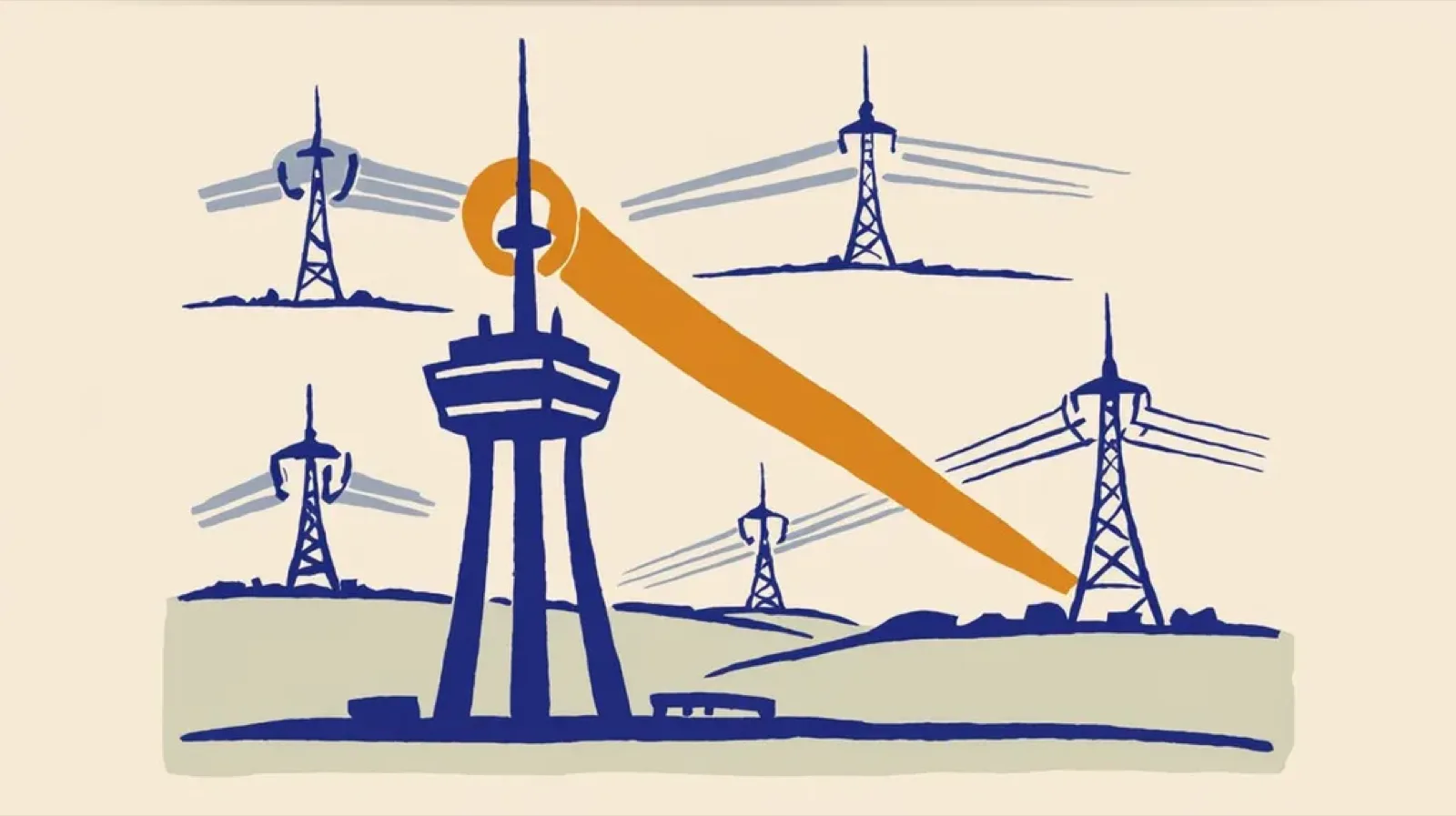
The term "customer engagement platform" appears in nearly every vendor pitch deck, yet the tools behind it share remarkably little DNA. One vendor means a campaign builder with drag-and-drop email flows. Another means a chatbot that deflects support tickets. A third means an API that fires a transactional SMS when a payment fails. All three call themselves customer engagement platforms, and all three are solving different problems for different buyers with different data models.
That fragmentation is not just a naming problem. It produces real operational costs: duplicated messages, inconsistent tone, blind spots between teams, and users who stop reading because they receive too much from too many systems. The fix is not another point solution. It is a shared orchestration layer that sits above channels and below experiences, routing every message (lifecycle, product, transactional) through a single set of rules.
This article breaks down why the category is splintered, what fragmentation actually costs, where the highest-leverage problem sits, and what message orchestration looks like in practice. It closes with a capabilities framework and an evaluation checklist for teams comparing platforms today.
The current age of customer engagement: three stacks, three operating models
The "customer engagement platform" label now covers at least three distinct tool categories, each optimized for a different team, a different data model, and a different definition of "customer." Understanding those differences is the first step toward seeing why orchestration is necessary.
Campaign-centric marketing clouds: powerful, expensive, and data-constrained
Marketing clouds like Braze, Iterable, and legacy ESPs were built around the campaign as the atomic unit of work. Braze, for example, defines a CEP as a system combining data, channels, and orchestration, but the orchestration it describes centers on marketer-driven segments, scheduled sends, and A/B tests. The workflow is optimized for marketing teams who think in audiences and calendars.
That model works well for promotional campaigns and retention plays. It works less well when the trigger is a product event (a user just hit a rate limit, a teammate accepted an invite, a deploy failed) that needs to reach the right person on the right channel within seconds. Campaign tools can ingest events, but their data pipelines and segmentation engines were designed around batch cohorts, not real-time state.
Support automation and bots: reactive engagement with a narrow definition of "customer"
Support platforms (Zendesk, Intercom in its helpdesk mode, Freshdesk) define engagement as responding to inbound requests. Their messaging capabilities are oriented around tickets, resolution times, and deflection rates. Proactive lifecycle messaging and product notifications sit outside their core loop.
When support tools do send outbound messages (CSAT surveys, bot-triggered nudges), those sends are invisible to the marketing cloud and the transactional notification system. The user receives all three with no coordinating logic in between.
Transactional notification infrastructure: great delivery, weak experience governance
Nielsen Norman Group defines transactional notifications as messages tied to a user's relationship with a company or an ongoing transaction: order confirmations, password resets, service alerts. These messages are triggered by user actions or system events and are expected as part of service delivery. They are not optional marketing.
Transactional tools like SendGrid, Amazon SES, and Twilio solve delivery within a channel. SendGrid's Mail Send API, for instance, provides authentication, rate limits, and delivery tracking for email, but it has no opinion about whether the user also received three other messages in the last hour, or whether SMS would have been a better channel given the urgency. Delivery-only thinking produces reliable pipes with no experience governance.
The hidden cost of fragmentation: collisions, blind spots, and fatigue
When lifecycle campaigns, support messages, and transactional notifications each run through separate systems, no single layer knows what the user has already received. A customer whose payment just failed might get a dunning email from the marketing cloud, a "payment failed" transactional alert from the notification service, and a chatbot follow-up from the support platform, all within minutes. Each message is individually reasonable. Together, they erode trust.
Message fatigue is a systems problem, not a copy problem
Teams often respond to declining engagement rates by rewriting copy or redesigning templates. The deeper issue is volume and timing. Mao et al. (2022) distinguish between information overload and message fatigue: overload reduces a user's ability to process messages, while fatigue reduces their motivation to try. Both mechanisms suppress engagement, and both are driven by how many messages arrive in what timeframe, not by the quality of any individual message.
When three systems can each send without awareness of the others, frequency management becomes impossible. No amount of copy optimization compensates for a user who has already tuned out.
"Fire-and-forget" messaging creates reliability debt
Most teams monitor their APIs, databases, and application services with sophisticated observability stacks. Notifications get a different treatment: fire the API call, hope it lands, check open rates in a dashboard a few days later. Courier's write-up on notification observability calls out this asymmetry directly, noting that silent SMS failures, spam folder placement, and provider degradation often surface only when customers complain.
AWS draws a useful distinction between monitoring and observability: monitoring tells you something is wrong, while observability helps you understand why. Applied to messaging, monitoring means knowing your email bounce rate went up. Observability means tracing a specific user's password reset email through provider selection, delivery attempt, fallback, and final outcome. Without that traceability, notifications accumulate reliability debt that compounds silently.
Why the product-to-lifecyle message vector is the most interesting problem
Product-led growth changed the center of gravity for customer messaging. When the product is the primary acquisition and activation channel, the most important messages are triggered by what users do inside the product, not by which segment a marketer built last Tuesday.
Lifecycle messaging needs product data, not just marketing data
A trial user who just created their first project needs a different onboarding message than one who signed up and never logged in. That distinction requires real-time behavioral signals (events, feature flags, usage state), not just CRM attributes like company size or signup date. Campaign tools can receive these events via integrations, but the latency and data transformation required often mean the message arrives after the moment has passed.
The most effective lifecycle messaging treats product events as first-class triggers. "User completed onboarding step 3 of 5" should fire a contextual nudge within minutes, not land in a batch segment that runs overnight.
Transactional messages are part of the product, not a separate channel
A password reset email is product UX. A payment failure SMS is product UX. An invoice receipt is product UX. Users do not distinguish between "the app" and "the email the app sent." When transactional messages arrive late, land on the wrong channel, or contradict what the UI shows, the product feels broken regardless of whose system sent the message.
Treating transactional notifications as a delivery concern separate from lifecycle messaging creates a false boundary. Both message types share the same user, the same preference model, and the same trust surface. They belong in the same orchestration layer.
The missing layer: message orchestration
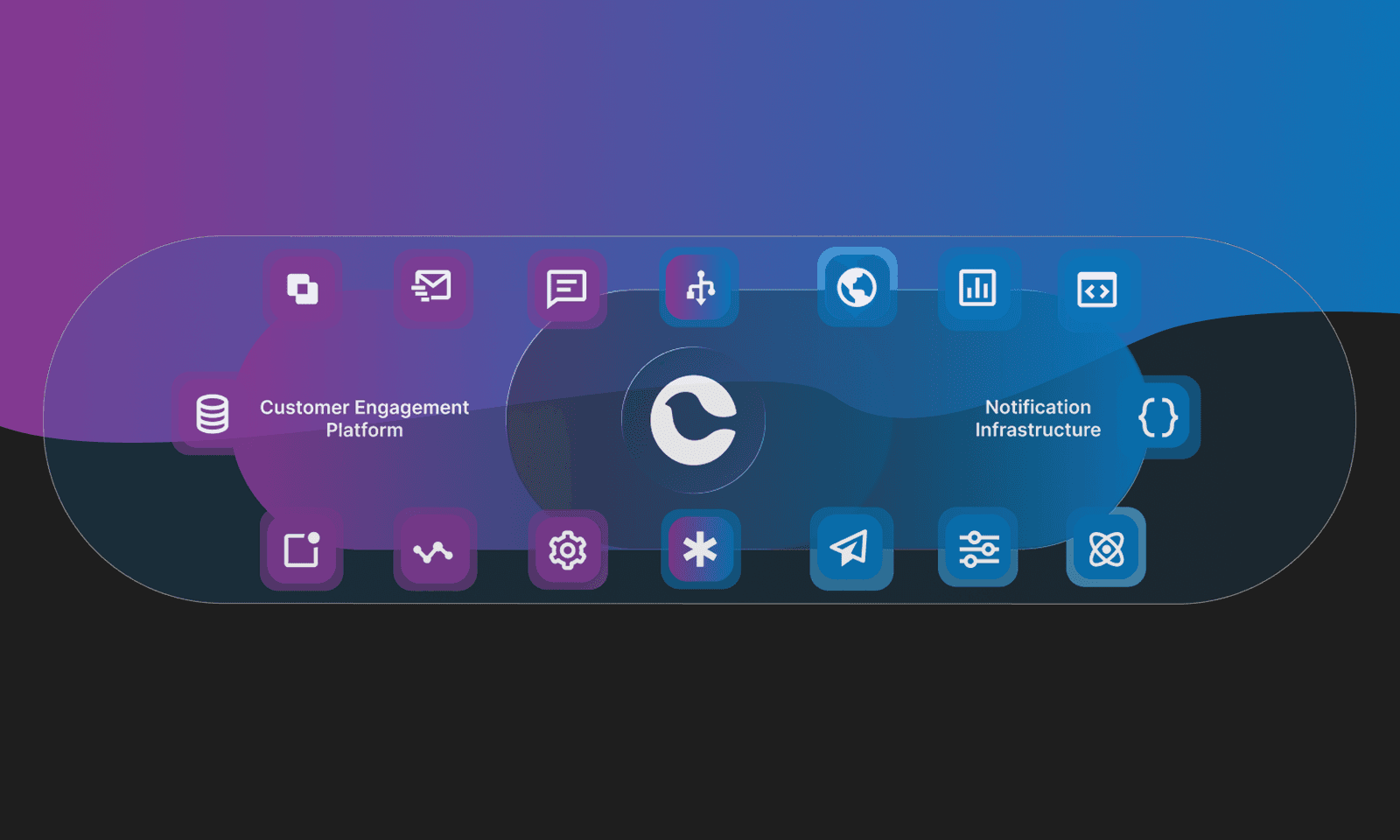
Message orchestration is a platform layer that sits above individual channel providers and below the experiences teams design. It owns the routing logic, preference enforcement, frequency governance, and delivery reliability that no single channel API or campaign tool handles end to end.
Journey orchestration exists, but it is often trapped inside campaign tools
Adobe defines customer journey orchestration (CJO) as tailoring each customer's experience using real-time insights to deliver the right message at the right time on the right channel. The definition is sound. The implementation, however, typically lives inside marketing clouds where journeys are built by marketers, triggered by segments, and limited to the channels the marketing platform supports.
Product and transactional workloads need journey-like sequencing (wait for event X, then send on channel Y, then check for event Z) without being routed through a campaign tool's audience model. Journey orchestration without infrastructure primitives like idempotent delivery, provider failover, and tenant-scoped routing breaks down outside the marketing use case.
Notification infrastructure exists, but it stops at sending
The inverse problem is equally real. Knock's manual on notification infrastructure describes the common evolution: a team integrates SendGrid for transactional email, adds Twilio for SMS, then Slack for workspace alerts. Each channel adds its own provider API, formatting rules, and failure modes. The complexity compounds quickly.
Knock frames notifications as messages sent when events occur, grouping them by purpose: informational, activation, and engagement. That taxonomy is useful because it shows that the "transactional vs. lifecycle vs. product" separation is artificial. The same event-driven system can serve all three purposes depending on context. What teams need is not another provider integration but an orchestration layer with routing, failover, queuing, and observability as standard primitives.
What "air traffic control for user messages" actually means
The metaphor is apt because air traffic control does not fly planes. It coordinates them: sequencing, routing, prioritizing, and preventing collisions. A message orchestration platform does the same for notifications. Courier positions itself as exactly this layer, describing "customer messaging, powered by product data" with a unified platform spanning lifecycle journeys, product notifications, and an in-app inbox, designed for product and engineering teams.
Here are the concrete capabilities that define the layer.
Any-channel delivery, with routing and failover
An orchestration platform abstracts individual providers behind a unified send API. If your primary email provider degrades, messages fail over to a secondary provider without application code changes. Channel selection (email, SMS, push, in-app, Slack, webhook) follows routing rules, not hardcoded logic. Courier supports this model with provider abstraction across channels so teams configure routing once and the platform handles delivery mechanics.
Journey building that spans lifecycle and product events
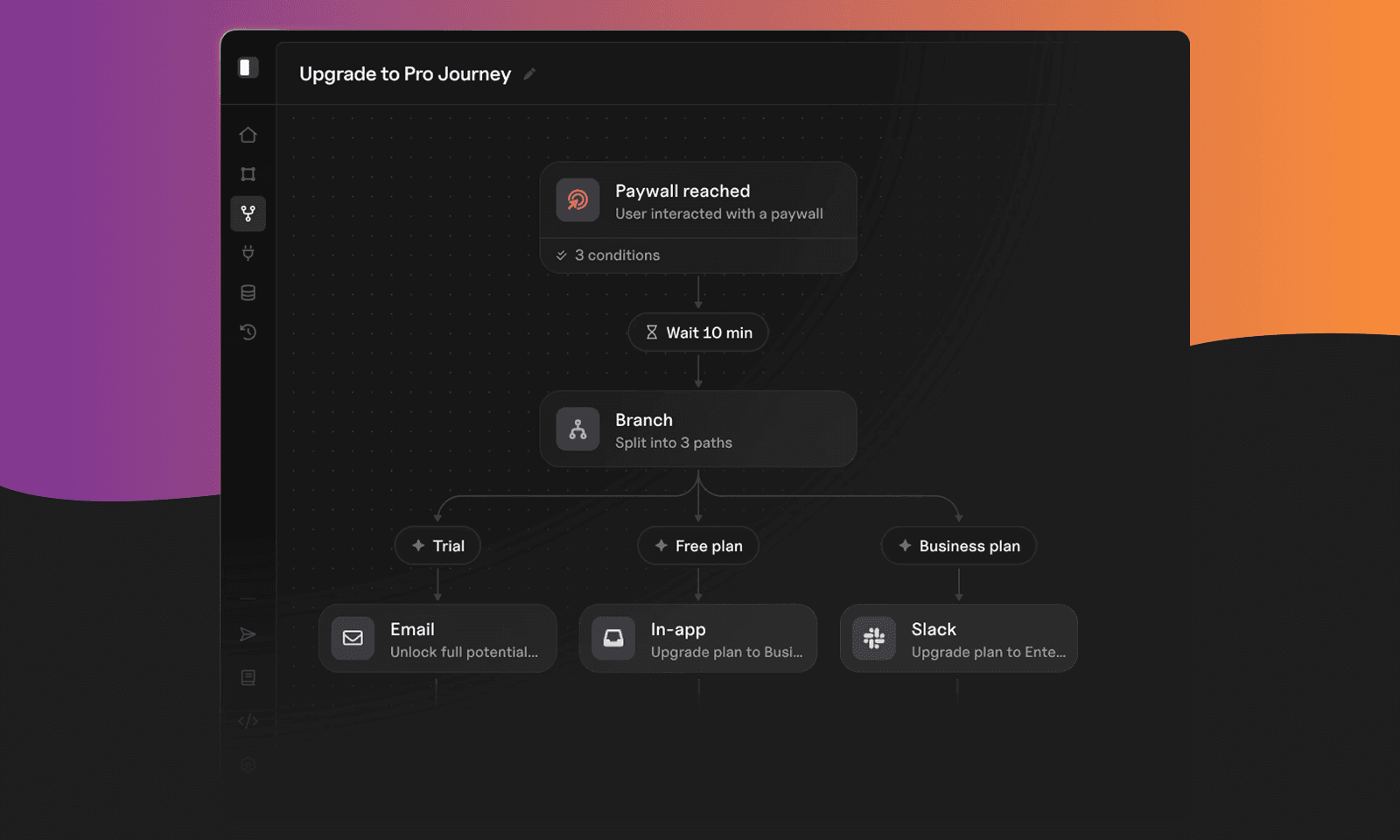
Multi-step flows should trigger on product events (user.created, invoice.payment_failed, project.shared) and proceed through conditional logic, delays, and branching, not just calendar-based sends. The distinction matters: a PLG onboarding journey that fires based on actual product milestones will always outperform a drip sequence that assumes every user moves at the same pace. Courier's journey builder is designed around this event-driven model.
Advanced routing, suppression, and prioritization
Global rules prevent collisions across message types. A suppression rule might say: "Do not send a marketing email within two hours of a transactional alert." A prioritization rule might say: "Security messages always take precedence over engagement nudges." These rules need to operate across teams and systems, which is why they belong in a shared orchestration layer rather than in any single campaign tool or notification service.
Template management as a shared system of record
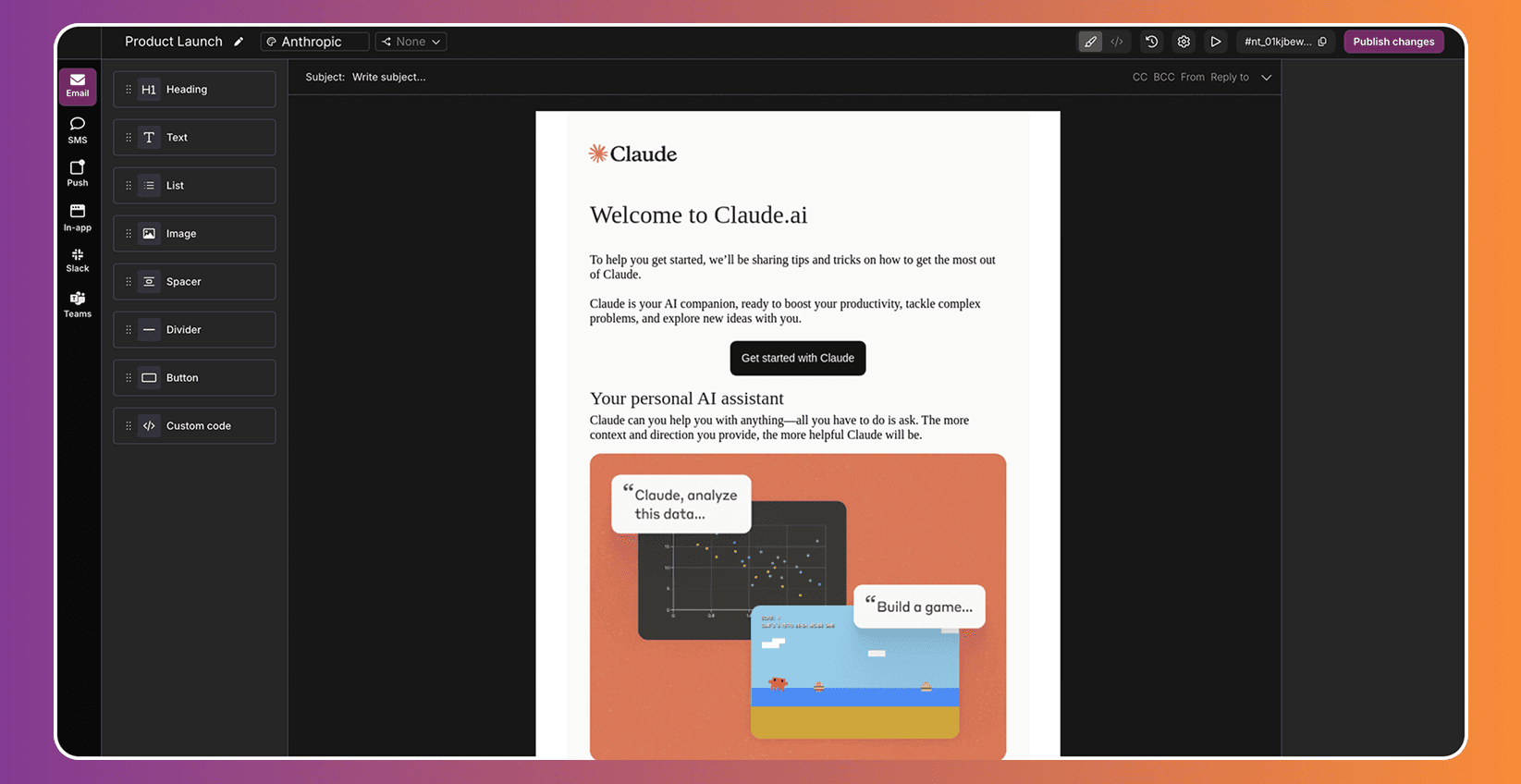
Templates should be versioned, previewable across channels, and editable by non-engineers without requiring a code deploy. When growth, product, and engineering teams all send messages, a single template system of record prevents drift (the email says one thing, the push notification says another). Courier provides a visual template editor with multi-channel preview and version history so teams collaborate on message content without blocking each other.
Multi-tenant operations for B2B SaaS and platforms
If your product serves multiple organizations (tenants), messaging complexity multiplies. Each tenant may need scoped branding, custom provider credentials (their own SMTP server or Slack workspace token), tenant-specific preferences, and send limits. Courier's tenant model supports parent-child hierarchies with up to four layers of inheritance, scoped preferences, custom branding, and tenant-specific credentials. Campaign tools were never designed for this operating model. Building it from scratch on top of raw provider APIs is a significant engineering investment.
Analytics and observability across the full message experience
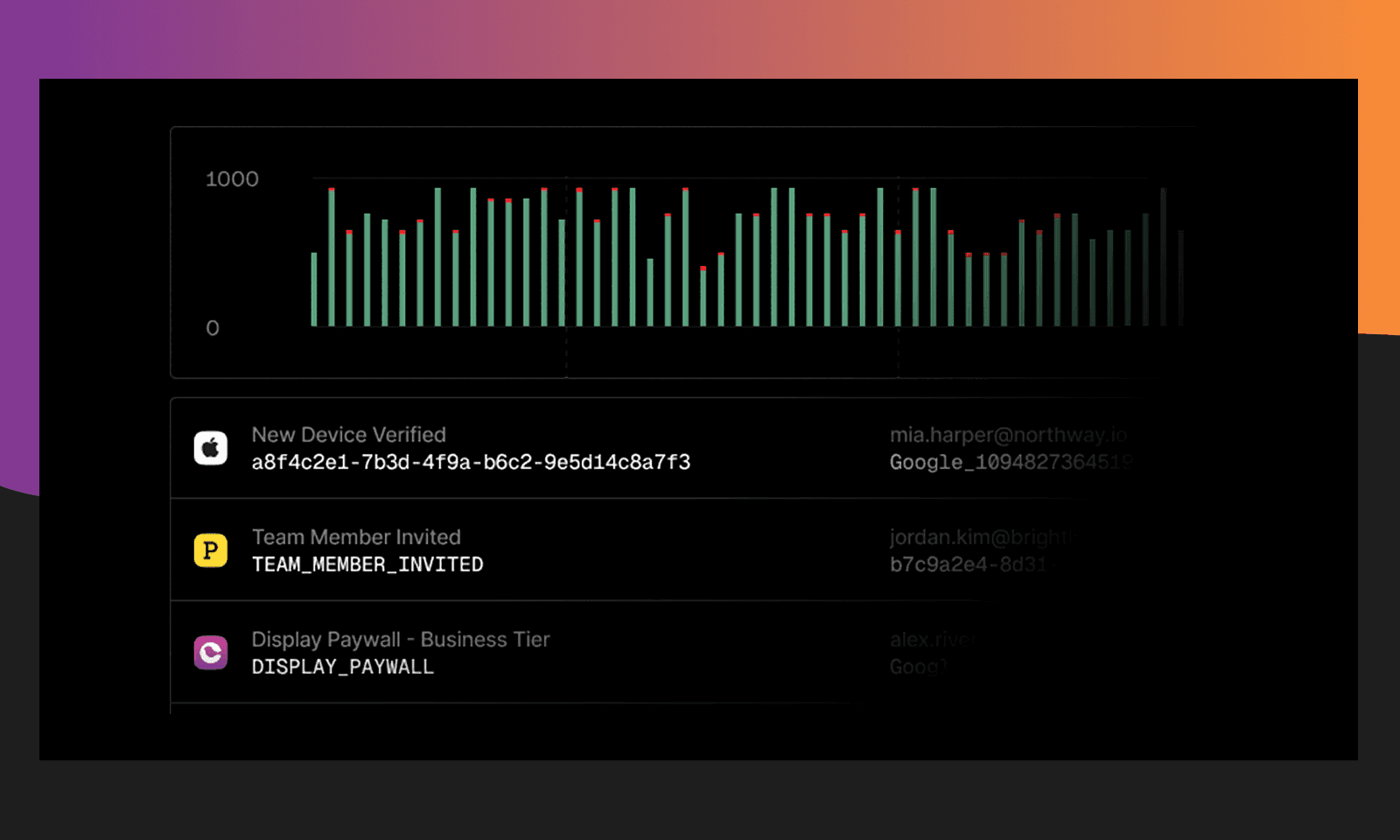
Message-level logs should show the full lifecycle of a notification: which event triggered it, which template was selected, which channel was chosen, which provider attempted delivery, and what the outcome was. Provider health dashboards should surface degradation before users notice. Engagement metrics (delivered, opened, clicked, acted on) should be accessible alongside application metrics in tools like Datadog, not siloed in a marketing dashboard.
A practical evaluation checklist for modern customer engagement platforms
When comparing platforms, these four dimensions separate orchestration systems from campaign tools and delivery-only APIs.
Data: event-driven, real-time, and accessible to engineering and growth
Can the platform ingest product events natively, not just via batch segment syncs? Does the data model support real-time behavioral signals alongside user attributes? Can engineering teams send events via API/SDK while growth teams build on top of them in a visual interface? Verify that data ownership remains with your team, not locked inside the vendor's proprietary segment builder.
Control: preferences, frequency, and policy enforcement across channels
Does the platform enforce user preferences (channel opt-outs, quiet hours) globally across all message types? Can you set frequency caps that span lifecycle, product, and transactional messages? Are there tenant-scoped preference overrides for B2B use cases? Without global control, each team ends up building its own suppression logic, which is how collisions happen.
Operations: reliability, auditability, and debuggability
Look for idempotent delivery (the same event does not produce duplicate messages), configurable retry logic, message-level audit logs, and provider failover. Can an engineer trace a specific notification from trigger to delivery outcome? Can the ops team see provider health in real time and set alerts for degradation? These are table-stakes requirements for any system that touches user trust.
Collaboration: shared templates and workflows without bottlenecking engineering
Can a growth marketer update email copy without filing a pull request? Can an engineer define a new event trigger without rebuilding the entire flow? The best orchestration platforms give each team appropriate control (visual editing for content, API/SDK access for data and triggers) while maintaining guardrails like approval workflows and version history.
| Dimension | Campaign tools | Delivery APIs | Message orchestration |
|---|---|---|---|
| Data model | Segment-centric, batch-friendly | Event-per-send, single channel | Event-driven, real-time, multi-channel |
| Control | Marketer-owned frequency rules | None (application code handles it) | Global suppression, prioritization, preferences |
| Operations | Campaign-level reporting | Provider-level delivery logs | Message-level traceability, provider failover |
| Collaboration | Marketer self-serve, engineering excluded | Engineering-only | Shared templates, role-appropriate access |
| Multi-tenant | Limited or absent | DIY per provider | Tenant-scoped branding, credentials, inheritance |
Closing: the category is converging, but the center of gravity is shifting
The customer engagement platform category is consolidating around a shared understanding: you need data, channels, orchestration, and analytics. Where vendors differ is which operating model they optimize for. Campaign-centric tools still assume the marketer is the primary operator and the campaign is the primary unit. Delivery APIs still assume the engineer is the sole user and the API call is the full scope.
The shift underway is toward orchestration as the center of gravity, where product events drive messaging logic, where lifecycle and transactional messages share governance, and where engineering and growth teams collaborate on a shared platform rather than maintaining parallel stacks. For product-led organizations, that shift is not a future aspiration. It is the current requirement.
Teams evaluating their customer messaging stack should start by asking a simple question: can one system trace a message from the product event that triggered it, through channel selection and preference checks, to delivery confirmation and user action? If the answer requires stitching together three dashboards from three vendors, the orchestration layer is missing. That is the problem worth solving next.
Similar resources

WhatsApp Business messages: types, templates, and rules
Every WhatsApp Business message is a template or a free-form message, and the type decides when you can send it and what it can look like. How businesses use each one, the template categories, the formats worth knowing, and the rules that stop messages from arriving.

WhatsApp pricing changes on October 1, 2026
On October 1, 2026, two things become billable on the WhatsApp Business Platform: free-form replies inside the 24-hour customer service window, and utility templates sent in response to a customer. If your WhatsApp volume is conversations rather than campaigns, this is not a rate tweak. It adds a line to your invoice where there used to be a zero. Here is what changes, a worked example of the cost, and what to check.

Clinical alert and notification systems: how escalation works
A clinical alert is easy to send and hard to close. This is how alerting works inside a hospital: where alerts come from, how routing by role and shift works, and how the acknowledge, timeout, escalate loop is actually built, including what happens when nobody answers.