Topic
Product Management
46 articles
Notification strategy for product teams: what to build, what to buy, and how to decide between transactional and marketing sends.

What's the Difference Between Omnichannel & Multichannel
Most teams say "omnichannel" when they mean "multichannel," and in most cases the distinction doesn't matter much. But if you truly want to provide an exceptional customer engagement experience you should know the difference. Both involve sending messages across email, push, SMS, Slack, and in-app. They terms diverge when those channels know about each other. Multichannel means you can reach users on multiple channels. Omnichannel means those channels share state, so a user who reads a push notification won't get the same message via email an hour later. This guide breaks down the real distinctions, when the difference actually matters, and which messaging platforms deliver true omnichannel coordination.

Personalization Beyond "Hello {{firstName || "there"}}!"
Using someone's name matters, just not for the reason most teams think. It builds familiarity over time but doesn't change what people do. The teams getting real results have moved past names to sending based on what users do and when it matters to them. This guide breaks down five tiers of personalization, shows where the gains actually come from, and helps you figure out where to focus. No machine learning needed for the tiers that matter most.

The First 48 Hours: Onboarding Notifications That Keep Users Around
The first 48 hours after signup are when users decide if your product is worth their attention. Every notification you send is an audition. Most teams blow it by sending too much too fast: welcome email, feature announcement, tip, CEO note. Day one and you've already trained users to ignore you. This guide breaks down what to send (and what not to send) in the critical first 48 hours, with timing frameworks, example sequences, and the one metric that matters more than open rate. Includes templates for signup confirmation, activation prompts, and day-two follow-ups.

What Is Alert Fatigue?
Alert fatigue occurs when users become desensitized to notifications due to high volume, leading to ignored alerts, missed critical information, and decreased engagement. This problem affects product notifications, DevOps monitoring, healthcare systems, and security operations. This guide covers the psychology behind alert fatigue (habituation and the "cry wolf" effect), how to measure it (open rates, dismiss rates, time-to-action), and five practical strategies to reduce it: batching, prioritization, user preferences, smart channel routing, and timing optimization.

SMS Opt-Out Rules in 2026
TCPA consent rules changed in April 2025. Consumers can now revoke consent using any reasonable method, including keywords like "stop," "quit," "end," "revoke," "opt out," "cancel," or "unsubscribe." Businesses must honor opt-out requests within 10 business days, down from 30. The controversial "revoke all" provision, which would require opt-outs to apply across all automated messaging channels, has been delayed until January 2027 and may be eliminated entirely. SMS providers like Twilio handle delivery infrastructure and STOP keyword responses at the number level. They don't sync opt-outs to your email provider, push notification service, or in-app messaging. That cross-channel gap is your responsibility. Courier provides unified preference management that enforces user choices across SMS, email, push, and chat automatically.

Customer engagement platform vs CRM: key differences
A CRM is a system of record. It stores who your customers are and what they've done, written by people and read by people. A customer engagement platform is a system of action: your product fires an event, and the platform decides who should hear about it, picks a channel they read, and delivers it. You'll likely end up running both, and the handoff between them is smaller than it sounds. Here's what separates the two on data, timing, preferences, and analytics, why their pricing models diverge more than their feature lists do, and how to tell which one your next problem needs.
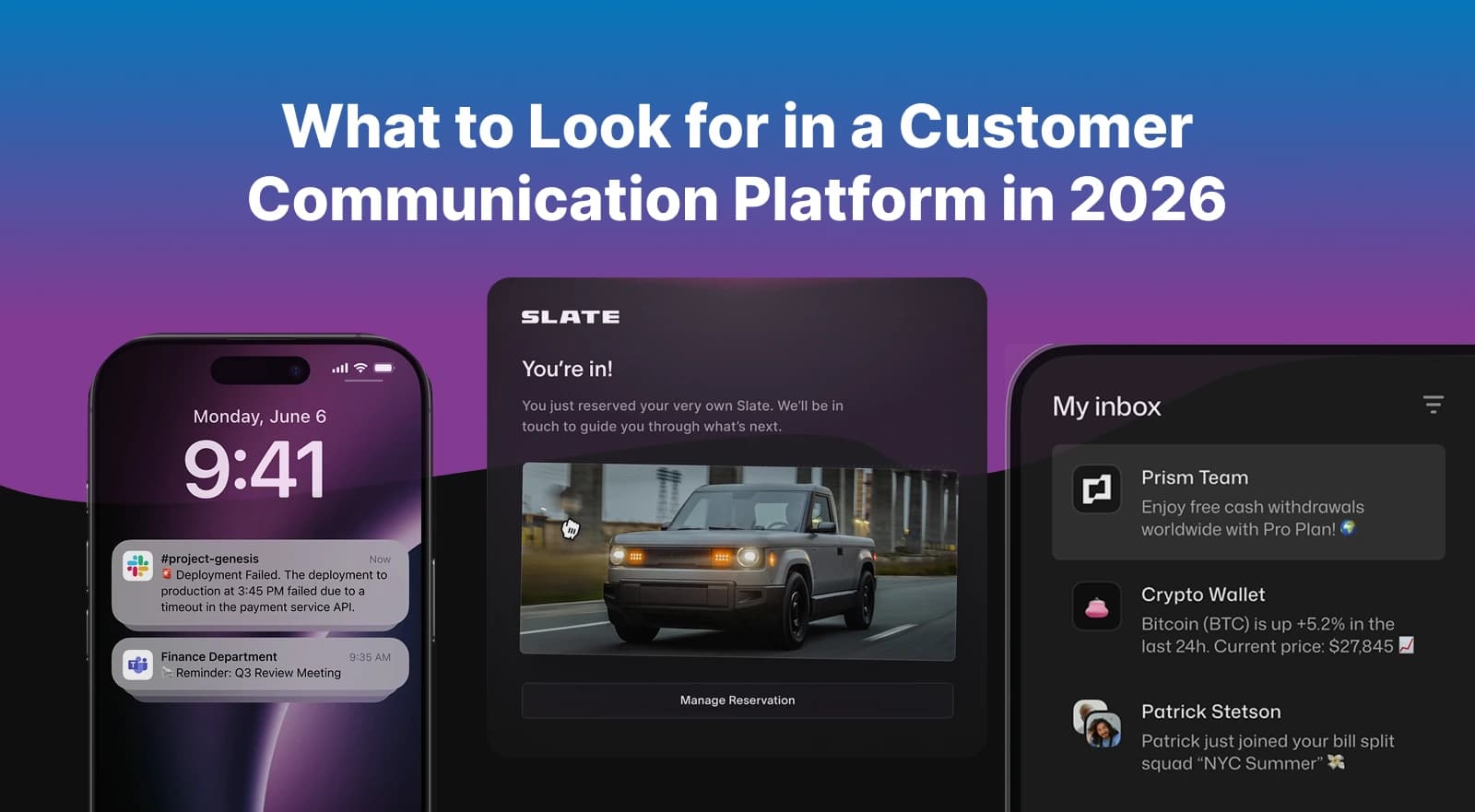
Customer Communication Platforms: What to Look for in 2026
Customer communication has evolved beyond batch-and-blast campaigns. Modern platforms must handle real-time event triggers, smart channel routing, visual journey orchestration, and compliance across multiple channels. This guide breaks down what to look for when evaluating customer communication platforms in 2026. We cover B2B customer journeys, business messaging (Slack, Teams, WhatsApp), drop-in preference centers, CDP integration, and analytics that actually help you improve. Includes comparisons of Courier, Customer.io, Braze, and infrastructure-first alternatives.
Top Platforms for Preference Management in 2025
73% of users unsubscribe from poorly targeted notifications. The problem: preference logic is scattered across marketing platforms, product notification systems, and multiple providers that don't talk to each other. Most preference tools handle marketing OR product notifications, not both. This guide compares 9 platforms for 2025, evaluating integration depth, compliance support (GDPR, CAN-SPAM, TCPA), and multi-channel capabilities across email, SMS, push, chat, and in-app. Includes SDK references, implementation examples, and MCP setup for AI-assisted configuration. Best for teams planning Q1 notification infrastructure improvements.
Twilio Integrations with Courier: SMS, SendGrid, Segment
Twilio owns critical notification infrastructure: SMS for billions of messages, SendGrid for email at scale, and Segment for customer data aggregation. Using them together means maintaining three APIs, three credential sets, and zero coordination between channels. Courier solves this by providing a single integration point for all three Twilio products. Connect your accounts, use one API to send across SMS and email, trigger notifications from Segment events, and orchestrate multi-channel delivery with routing rules and failover built in.